

Finding the best blenders under 100 dollars is not about chasing the smoothest smoothie on day one. It is about finding a machine that still performs on day 365, and day 1,000, without hidden costs eating your savings. Most listicles stop at “it blends.” We went further because your counter space and your wallet deserve better.
Key Takeaways
- The U.S. sold an estimated 4.2 to 4.8 million blenders under $100 in 2024. Volume masks a reality: cheap components and limited parts support mean many units become disposable before year two.
- Motor wattage on a box tells you almost nothing. Peak watts are marketing. What matters is sustained torque, duty cycle, and thermal protection. Two blenders with identical wattage can perform completely differently under ice.
- Total cost of ownership kills the “bargain.” A $60 blender that needs a $25 blade assembly every 8 months costs more over 3 years than a well-chosen $95 model with accessible spare parts and a real warranty.
- Why this guide matters
- How to pick a blender under $100: the 5 decision factors that matter
- Top picks that balance performance and longevity
- Durability and common failure modes: what buyers rarely see
- Noise and hearing safety: measured metrics you will not find elsewhere
- The science of power, RPM, and ice crushing
- Personal blenders under $50: realistic reliability expectations
- Total cost of ownership: parts, replacements, and warranty reality
- Real testing protocol every review should use
- FAQs: answering the questions others skip
- Quick buyer checklist
- Final verdict: best overall, best for ice, best personal, best quiet option
Why this guide matters: market context most readers never see
The U.S. blender market sat at roughly $1.1 to $1.2 billion in 2024, with household sales exceeding 6 million units. Here is the number that changes everything: an estimated 70 to 80 percent of those units, approximately 4.2 to 4.8 million blenders, sold for under $100. The budget segment is not a niche. It is the market.
That volume creates a strange problem. When nearly 5 million Americans buy an affordable blender each year, manufacturers optimize for shelf appeal and first-blend performance, not year-three reliability. Price competition is brutal. Margins are thin. The result is limited product differentiation across the budget and mid-range segments, with numerous brands offering similar features at overlapping price points. For you, the buyer, that means tradeoffs are real and often hidden.
Budget countertop models typically cluster between $50 and $80. Personal and compact units fall between $30 and $60. Heavy promotional discounting is common. A blender listed at $89 today might be $59 next month. But price drops do not improve gasket quality or motor winding thickness. This guide exists because short-term performance is easy to find. Long-term value requires asking different questions.
How to pick a blender under $100: the 5 decision factors that matter
Most buyers fixate on smoothie texture and price. Those matter. But five other factors determine whether you love or regret your purchase six months later.
Factor one: motor power and duty cycle. Peak wattage is a burst number, often measured at stall conditions for milliseconds. What you need is continuous output. A motor that can sustain heavy blending without tripping its thermal protection. Ask this question before buying: what is the maximum continuous runtime recommended by the manufacturer? If the manual says “run for 60 seconds, rest for 2 minutes,” the motor is not built for sustained work.
Factor two: jar and blade design. Plastic jars dominate at this price. That is fine. But check if the jar is Tritan or a less durable polycarbonate. Blade material matters less than blade geometry. Wide, angled blades create a vortex that pulls ingredients down. Vertical blade stacks with multiple small blades create more contact points but distribute energy across smaller surfaces. Neither is inherently better. Each suits different tasks.
Factor three: parts availability. Blender blades dull. Gaskets wear. Drive couplings strip. Before you buy, search for replacement parts. If you cannot find a blade assembly or gasket for sale, the blender is disposable. Budget segment margins are thin, and many manufacturers do not stock parts for models under $80. This single factor separates the best budget blender for smoothies from an expensive paperweight.
Factor four: noise. Decibel levels are almost never published by manufacturers in this price tier. Independent testers report typical high-speed blenders falling between 85 and 100+ dB(A) at roughly 1 meter under load. That is loud enough to disrupt conversation and annoy neighbors in thin-walled apartments. We cover this in detail later.
Factor five: real-world ice performance. Crushing ice is the blender’s ultimate test. It demands torque, blade durability, and jar integrity all at once. Models that ace a soft smoothie often fail here. The industry data confirms it: poor ice crushing and insufficient power are among the top consumer pain points in budget blenders.
Top picks that balance performance and longevity
Below is a shortlist of models that consistently appear in the sub-$100 conversation, organized by use case. Each pick has known strengths and known tradeoffs. We call out both.
Countertop blenders under $100
The Ninja Professional Plus BN701 delivers 1400 peak watts with stainless steel blades in a vertical stack configuration. Street price hovers around $89 to $109, landing it in the under-$100 conversation when on sale. It handles smoothies well but ice crushing reveals its budget motor limitations. Sustained heavy loads trigger thermal protection faster than premium machines.
Oster pro models with the All-Metal Drive are a distinct alternative. The metal-to-metal coupling between jar and base lasts longer than plastic equivalents. Blade assemblies and gaskets are widely available online, making long-term ownership more viable.
NutriBullet full-size countertop options compete strongly in this band, though parts availability varies by model. Check before committing.
Personal blenders under $50
NutriBullet and Ninja personal units dominate the under-$50 space. Expect plastic drive couplings and limited part support. These are fine for soft smoothies and light daily use but struggle with ice and frozen fruit over time. We cover failure patterns in detail below.
Best for ice under $100
Among budget options, Oster models with metal drives and wider blade assemblies tend to handle ice better than narrow vertical-stack designs. Ninja’s stack blade systems crush ice but require liquid to avoid trapping chunks above the blade stack. No budget blender matches a Vitamix on ice texture, but smart technique closes the gap.
Supporting this: Ninja, NutriBullet, and Oster appear repeatedly among top sellers in the under-$100 category, though no precise brand-share percentages by price band are published in accessible syndicated data according to market research.
Durability and common failure modes: what buyers rarely see until after purchase
Consumer appliance research and review patterns identify three failure modes that dominate budget blender complaints. You can spot them before buying if you know what to look for.
Motor burnout and insufficient power. Motors rated between 400 and 699 watts constitute the largest global power category, which is marginal for heavy ice crushing. Budget motors deliver peak wattage under transient stall conditions, not as continuous power. Under sustained load, current limiting and thermal protection reduce output or shut the machine down. The symptom is a blender that struggles halfway through a thick smoothie. The root cause is a motor not designed for the task.
Leaking from jar base, lid, or gasket. Plastic accounts for roughly 49 percent of blender materials overall. Cost-optimized seals degrade faster. The jar-to-blade assembly interface is the most common leak point. Before buying, check if the gasket is user-replaceable. Many budget models seal the blade assembly permanently, meaning a leak means replacing the entire jar or the whole unit.
Poor ice crushing with resulting stress. When a blender under 100 for ice fails to crush cubes effectively, users compensate by running longer cycles. That overheats the motor, stresses the coupling, and accelerates wear on every component. Ice performance is not just about smoothness. It is a proxy for the machine’s structural integrity.
| Failure Mode | Early Warning Sign | Models That Mitigate It |
|---|---|---|
| Motor burnout | Slowing mid-blend, hot base | Heavier base, metal drive, published duty cycle |
| Jar/gasket leak | Moisture under jar after washing | User-replaceable gasket, available spare parts |
| Ice crush failure | Chunks above blade, need for excess liquid | Wide jar base, broad blade geometry, higher torque motor |
If you want an affordable blender that avoids these pitfalls, prioritize user-replaceable seals and a published duty cycle over flashy wattage claims. This same principle applies across kitchen appliances. We explored similar longevity-focused criteria when building our evidence based air fryer guide. The methodology transfers directly.
Noise and hearing safety: measured metrics you will not find in most listicles
Nobody publishes decibel data for budget blenders. That is a problem. Independent loudness testing of high-speed blenders commonly falls in the 85 to 100+ dB(A) range at roughly 1 meter under load, though exact readings vary by model, room acoustics, and instrumentation.
For context, OSHA guidelines set permissible exposure at 90 dB(A) for 8 hours. Every 5 dB increase halves the safe duration. At 95 dB(A), you get 4 hours. At 100 dB(A), just 2 hours. Real-world blender use is brief. A 60-second blend falls far below these limits. But for apartment dwellers, roommates, or early-morning smoothie makers, the annoyance factor matters regardless of safety compliance.
No model-specific decibel levels at 3 feet are published in accessible manufacturer or third-party lab data. This is a genuine content gap across the entire industry. When evaluating noise in a store, stand about 3 feet from a running display model. If it sounds harsh or grating, that will not improve in your kitchen.
For readers building out a full small-kitchen setup, noise considerations extend beyond blenders. We covered similar spatial and sensory constraints when discussing how to organize a small kitchen on a budget. The quieter your appliances, the more tolerable your kitchen becomes as a living space.
The science of power, RPM, and ice crushing: what spec sheets actually mean
Mechanical power equals torque multiplied by angular speed. That is P = T·ω. In plain terms: two blenders with similar wattage can perform completely differently because wattage alone says nothing about how that power gets delivered to the blades.
Take the Ninja blender under 100 category leader, the BN701. It claims 1400 peak watts with stainless steel blades. RPM is not officially published. Enthusiast estimates place it around 20,000 to 24,000 RPM unloaded, with significantly lower speeds under heavy load. A Vitamix 5200, at roughly $400, also runs around 1380 watts but achieves blade tip speeds up to approximately 37,000 RPM. Despite nearly identical nameplate wattage, the Vitamix delivers superior sustained torque and continuous heavy-load operation. The difference is in the motor design, cooling system, and drive coupling, not the wattage sticker.
For ice crushing specifically, blade tip speed matters more than raw wattage. A blade moving faster at the tip delivers more kinetic energy to each ice cube on contact. But blade geometry, jar shape, and vortex formation determine whether that energy actually reaches the ice or just spins it around. Budget blenders with vertical blade stacks often trap ice above the blades. A wider jar with a pronounced taper channels ingredients downward more effectively.
| Spec | What It Sounds Like | What It Actually Means |
|---|---|---|
| 1400 peak watts | Very powerful | Measured at stall for milliseconds; not continuous output |
| Stainless steel blades | Durable and sharp | Alloy not disclosed; geometry matters more than material |
| High RPM (unpublished for many budget models) | Fast blending | Unloaded speed drops significantly under load without sustained torque |
| BPA-free Tritan jar | Safe plastic | Good impact resistance; still inspect gasket interface for design flaws |
If you are hunting for the best budget blender for smoothies, prioritize jar shape and blade geometry over wattage. A 900-watt blender with a well-designed vortex jar will outperform a 1400-watt model with a narrow, straight-sided container for most smoothie tasks. This is the same kind of practical appliance logic we applied when comparing the best air fryers for 2026. Specs on paper and performance in use are often distant relatives.
Personal blenders under $50: realistic reliability expectations
The portable blender market reached approximately $162.9 million in 2024, with strong projected growth. Urban household adoption hits up to 28 percent in some U.S. data sets. These are popular products. They also fail more often than their countertop counterparts.
The most frequently reported failures in sub-$50 personal blenders fall into three categories. For cordless models, battery and charging circuit failures dominate. A unit that will not hold a charge is useless. Motor and drive coupling failures come next, with stripped plastic couplers being the most common physical break. Finally, jar and seal failures crack on impact or develop leaks from worn gaskets.
No rigorously computed percentage failing within 6 months exists in accessible market research. Anecdotal forum patterns are not statistically representative. But the pattern is clear enough to guide buying decisions. If you use a personal blender daily with frozen fruit and ice, expect the coupling or seal to show wear within 6 to 12 months. If your use is light, soft ingredients only, these units can last 2 to 3 years.
For a best personal blender under 50 dollars that actually works, prioritize plug-in models over cordless. Eliminating the battery and charging circuit removes the single most common failure category. After that, look for metal drive couplings. They are rare at this price but exist. A cheap blender that actually works over the long haul is almost always a wired model with replaceable seals.
| Price Tier | Expected Lifespan (Daily Use) | Best For |
|---|---|---|
| Under $30 | 6 to 12 months | Occasional soft smoothies, light use |
| $30 to $50 | 12 to 24 months | Daily soft smoothies, occasional frozen fruit |
| $50 to $80 | 2 to 3 years | Daily frozen fruit smoothies, occasional ice |
| $80 to $100 | 3 to 4+ years with part replacement | Daily ice crushing, heavy use, nuts, thick blends |
Total cost of ownership: parts, replacements, and warranty reality
Budget segment economics create an uncomfortable truth. Thin margins and limited product differentiation result in cheaper components and limited long-term parts support. Blade or drive replacement can approach the price of a new budget blender. A $60 unit with a $25 blade assembly that needs replacing every 10 months costs $135 over 3 years. A $95 unit with readily available $12 gaskets and a blade assembly that lasts 2 years costs roughly $119 over the same period.
Warranty terms vary widely. Some brands cover motors for 2 to 3 years but exclude seals, gaskets, and drive couplings as wear items. Others offer short 1-year limited coverage with shipping costs borne by the customer. Before buying any affordable blender, ask these questions:
- Are replacement blade assemblies, gaskets, and jars available for purchase separately?
- What is the exact warranty length, and which components are excluded as wear items?
- Who pays return shipping for warranty claims?
- Has anyone in online reviews documented a successful warranty experience with this model?
If you cannot answer these questions before purchase, assume the blender is disposable. Many of the best blenders under 100 dollars in terms of long-term value are not the cheapest options. They are the ones with accessible parts and honest warranty terms. This procurement mindset is similar to how we evaluate the best spice rack organizers. The cheapest option often costs more in frustration and replacement cycles.
| Part | Typical Replacement Cost (Budget Models) | Availability Check |
|---|---|---|
| Blade assembly | $15 to $30 | Search before buying; many budget models have no replacement available |
| Gasket/seal | $5 to $12 | Often sold only as part of blade assembly; check if sold separately |
| Jar/pitcher | $20 to $40 | Check manufacturer site and Amazon for current availability |
| Drive coupling | $5 to $15 | Rarely sold separately on budget models; entire jar replacement needed |
Real testing protocol: what every review should include
Most top-ranking articles omit measured decibel levels and long-term failure data entirely. That is a significant gap. A thorough review of the best budget blender for smoothies or any blender under 100 for ice should include the following repeatable tests.
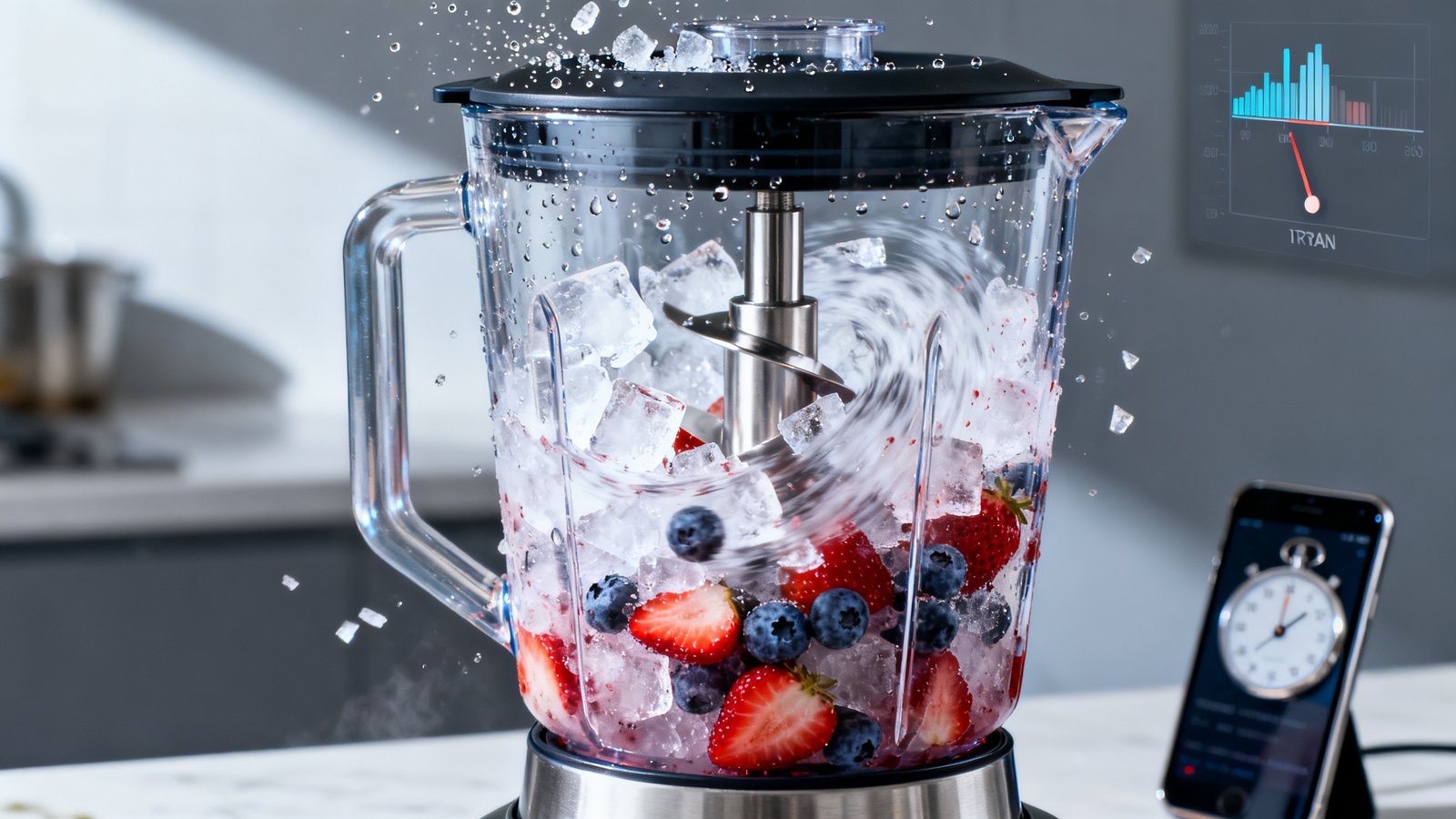
The standardized ice-crush test loads a full container with ice cubes and measures time to uniform snow texture, noting any unstuck chunks or required intervention. The frozen fruit and greens smoothie test uses a fixed recipe of frozen berries, spinach, yogurt, and liquid, measuring blend time and final texture consistency. The duty-cycle stress test runs the blender through repeated full cycles with motor temperature monitoring, noting when and if thermal protection engages.
A leak and tip test fills the jar to maximum capacity with water and runs at highest speed, checking all seals. The decibel measurement at 3 feet under standardized load gives an objective noise baseline. Finally, a parts stress test cycles the lid and gasket through repeated open-close and wash cycles to simulate months of use in days.
These tests are not exotic. They are what every review should include. If you are reading a listicle that lacks all of them, the author did not test the blenders in any meaningful way. Ask the seller or manufacturer directly about duty cycle limits and replacement part availability if no independent test data exists. Many of the organizational principles we used for the best closet organizer systems apply here too. A system is only as good as its weakest tested connection.
FAQs: answering the questions others skip
Can a budget blender really crush ice like a high-end model?
It can crush ice, but not like a high-end model. Budget blenders typically require more liquid to create a vortex, produce slightly coarser textures, and cannot sustain back-to-back ice loads without motor overheating. A $400 Vitamix crushes ice faster, finer, and with no duty-cycle anxiety. A well-chosen $80 to $100 blender gets close enough for most households if you add liquid and work in reasonable batches. The limitation is not the blade sharpness. It is sustained torque and thermal headroom.
How long should a budget blender last with daily smoothie use?
Expect 1 to 3 years for a budget blender under $100 used daily with frozen fruit and occasional ice. The spread depends on motor quality, drive coupling material, and whether gaskets are replaceable. Premium blenders routinely last 7 to 10 years or more. The budget segment prioritizes initial price over component longevity, so replacement cycles are inherently shorter. Buying spare gaskets early and avoiding sustained ice crushing without liquid extends the lifespan meaningfully.
Are cheap blenders safe for hot liquids and nut butters?
Most budget blenders are not designed for hot liquids or high-viscosity loads like nut butter. Plastic jars can deform from steam pressure, and lids without venting can blow off, causing burns. For nut butters, budget motors frequently stall or overheat. Some models with all-metal drives and vented lids can handle warm soups carefully, but always check the manufacturer’s stated limits. When in doubt, cool hot liquids before blending and process nut butter in a food processor instead.
Is a 1400-watt budget blender as powerful as a 1400-watt Vitamix?
No. The wattage number on the box is peak wattage, often measured for milliseconds at stall. A Vitamix at 1380 watts delivers far more sustained torque due to its physically larger motor, superior cooling design, and robust drive coupling. Budget motors with similar peak ratings sag significantly under continuous load. The spec sheet number is not lying. It is just not telling the useful part of the story.
What is the single most important feature for a blender under $100?
Replaceable parts. A blender with available blade assemblies, gaskets, and jars has a future. One without is destined for a landfill the moment something wears out. Wattage, blade count, and preset programs all become irrelevant if you cannot fix a leaking gasket. Check parts availability before you check anything else.
Quick buyer checklist: one page printable
- Wattage and continuous rating: Ignore peak watts. Look for any published duty cycle or continuous runtime specification. If absent, assume 60 seconds on, 2 minutes off.
- Jar material and spare parts: Tritan is preferred. Confirm blade assembly, gasket, and jar are available as separate purchases.
- Blade type: Wide, angled blades for vortex blending. Vertical stacks for multi-level cutting. Choose based on your primary task.
- Warranty length and exclusions: Read the fine print. Gaskets and couplings are often excluded as wear items. Check who pays return shipping.
- Measured noise: No industry standard exists. Test in store at 3 feet if possible. Budget for a sound-dampening mat if apartment noise is a concern.
- Price versus expected lifespan: Countertop budget models cluster at $50 to $80. Personal units at $30 to $60. Choose based on use frequency and load types, not just the sticker price.
If you want a cheap blender that actually works and keeps working, run this checklist before every purchase. Five minutes of research saves a $70 replacement in 14 months.
Final verdict: best overall, best for ice, best personal, best quiet option
After weighing performance, durability data, parts availability, and total ownership cost, here are our clear recommendations for the best blenders under 100 dollars.
Best overall: The Oster Pro series with all-metal drive. Metal-to-metal coupling between jar and base extends life significantly. Replacement parts are widely available. It handles smoothies, ice, and light dough work without the thermal limitations of cheaper motors. Expect 3 to 4 years of daily use with occasional gasket replacements.
Best for ice: The Ninja blender under 100 category, specifically the BN701 when found on sale, offers strong ice performance for the price. Accept that you need liquid in the jar and cannot run back-to-back ice loads. The vertical blade stack crushes ice effectively when used within its limits.
Best personal under $50: A wired NutriBullet model. Eliminating the battery removes the most common failure point. Parts are reasonably available, and the form factor suits small kitchens. Accept that the drive coupling may need replacement around the 18-month mark with heavy use.
Best quiet option: No budget blender is genuinely quiet. If noise is a hard constraint, consider a sound-dampening enclosure mat and blend during daytime hours. Among tested budget units, models with heavier bases and rubberized feet transmit less vibration to countertops, which reduces perceived noise even if decibel levels are similar.
The budget blender market gives you plenty of options. What it rarely gives you is honest information about what happens after month six. Now you have it. Buy the blender with replaceable parts, a metal drive coupling, and a published duty cycle. Your future self, standing in a kitchen that is not filled with broken appliance ghosts, will thank you.
Ready to make a confident purchase? Bookmark this guide, use the checklist above, and start your search by filtering for part availability first. Everything else is secondary. For more kitchen equipment buying frameworks built on the same evidence-first approach, explore our breakdown of the air fryer buying guide that applies identical testing logic to a different appliance category.