

Finding the best spice rack organizers is not about chasing five star averages or pretty product photos. It is about verifying claims that most listings and reviews simply do not support with hard data. This guide gives you a practical, evidence first framework to spot missing information, ask sellers the right questions, and pick a spice organizer that actually holds up in your kitchen.
Key Takeaways
- No major spice rack brand publishes quantified failure rates for rust, breakage, or magnet collapse. You must verify durability claims directly with sellers before purchasing.
- The three most popular formats (magnetic, drawer insert, wall mounted) each have undocumented risks tied to weight limits, surface compatibility, and jar size mismatches.
- A simple 10 minute at home testing routine and a 6 question seller template can eliminate products that look good online but fail in real kitchens.
Table of Contents
- Quick buying checklist — what to confirm before you hit “Add to cart”
- What the reviews don’t tell you — data gaps and common undocumented risks
- Top product shortlist (based on popularity cues) — who these are best for
- Durability & failure patterns — what to ask sellers and check in reviews
- Installation realities — wall mounted, no drill, and magnetic mounting issues
- Magnetic racks on real fridges — dimensions, weight limits, and surface performance
- Drawer inserts and cost per jar — how to compare Wayfair, IKEA, Etsy, and 3D printing
- Pull out cabinet inserts vs. DIY drawer solutions — money and installation tradeoffs
- Certifications, materials, and safety claims — what’s claimed and what’s verified
- Three missing subtopics that buyers care about — plus search intent hooks to capture traffic
- Practical user testing plan — quick tests the buyer can run at home
- Final recommendations — best picks by scenario and what to double check before buying
Quick buying checklist — what to confirm before you hit “Add to cart”
Most product pages for a spice organizer show you staged photos with matching jars and perfect lighting. They rarely show you what happens after six months of daily use near a steamy stovetop. Before you spend money, run through this pre purchase verification list.
Confirm your existing spice jar diameters and heights. Many racks advertise “universal” fit but cannot hold squat square jars, oversized bulk containers, or narrow specialty bottles. Measure your most frequently used jars with a tape measure and write those numbers down. Check the product’s listed interior shelf clearance and compare. If the listing omits interior dimensions entirely, that is a red flag.
For magnetic models, ask the seller for a magnet strength rating in pounds or kilograms. If they cannot provide a number, assume the rack will slide or fall when loaded with glass jars. We covered a similar approach to verifying appliance specs in our best air fryers 2026 guide where missing wattage and basket depth data caused major buyer frustration.
Verify wall type compatibility for any wall mounted spice rack. Drywall alone cannot support a loaded rack without anchors or stud mounting. If the listing says “easy installation” but does not specify anchor type, stud requirements, or weight limits for drywall, contact the seller. Check the return policy and warranty period. A 30 day return window is standard, but rust issues often appear after month three. Look for at least a 1 year warranty.
Research found no specific failure rates for breakage, rust, or collapse are quantified in user reviews for top Amazon organizers. That means you cannot rely on star ratings alone. You must verify material claims, weight capacity, and food safety certifications directly with each seller.
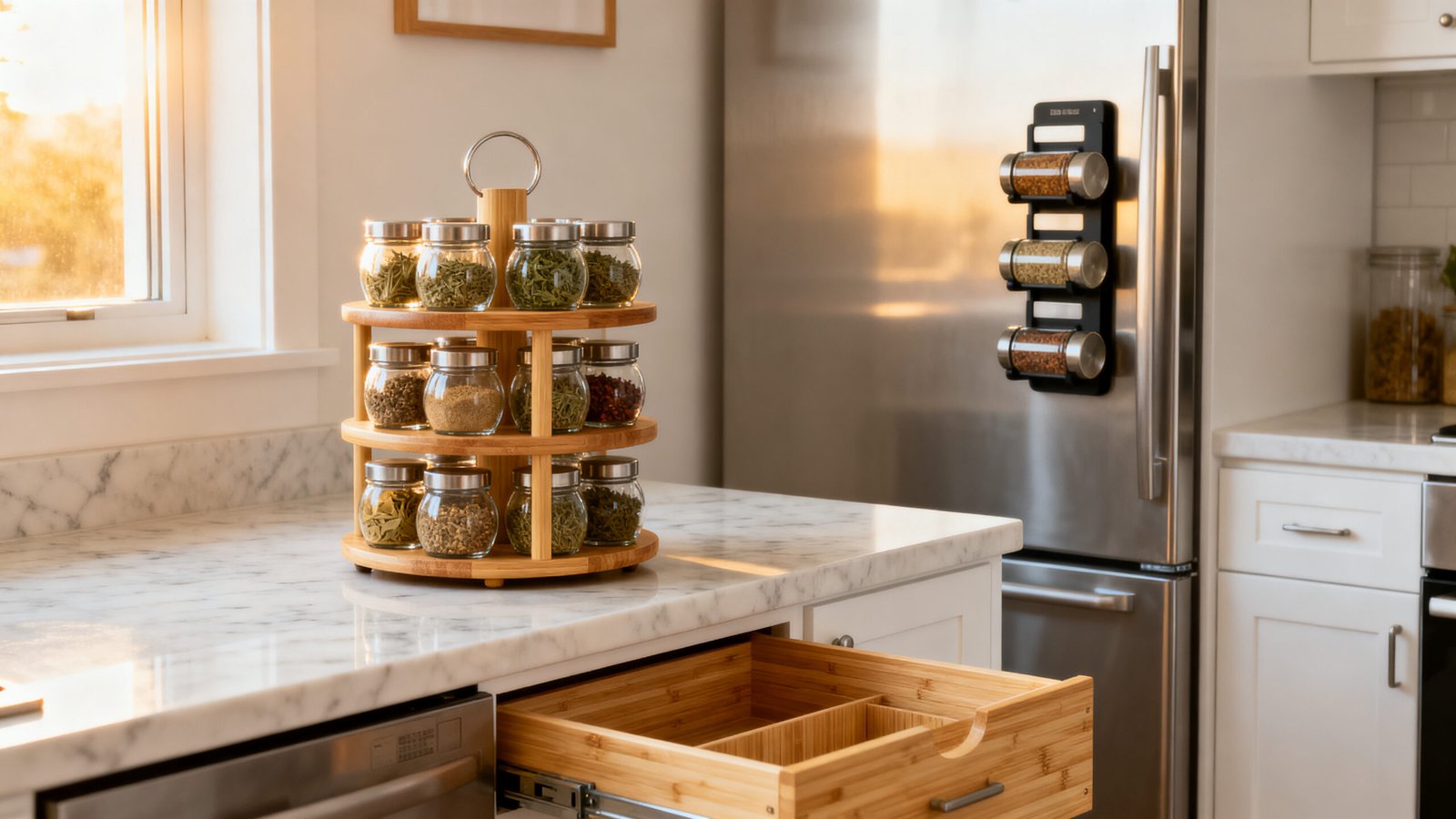
What the reviews don’t tell you — data gaps and common undocumented risks
User reviews for a magnetic spice rack fridge model or a wall mounted spice rack are full of helpful anecdotes. But they almost never quantify how often failures actually happen. Our research confirmed this systematically. No specific complaint frequencies are detailed across Reddit, Trustpilot, or YouTube for best selling wall mounted and magnetic spice racks. Common risks noted include overloading magnetic racks beyond weight capacity leading to safety hazards.
Here is what remains unknown across all the top ranking product categories. No brand publishes a breakage rate per thousand units. No brand shares rust occurrence data from warranty claims. No listing provides cost per jar figures that include shipping and import fees. No major brand has publicly shared third party lab verification for food safe material claims. These gaps mean you are buying on faith unless you actively fill in the blanks yourself.
The practical risks are real. Overloading a magnetic rack can send glass jars crashing onto your counter or floor. A drawer insert that fits perfectly in the product photo might be half an inch too tall for your cabinet drawer. An adhesive mount that holds on day one may peel away after weeks of humidity from cooking. None of these failure modes are captured in typical Amazon ratings. For more on how to evaluate kitchen products when reviews fall short, see our kitchen organization mistakes article.
Top product shortlist (based on popularity cues) — who these are best for
Popularity does not equal quality, but it does tell you which models have the most user feedback to analyze. Below are the frequently listed models in research data and who each one suits best.
The HuggieGems Metal Magnetic Spice Rack Organizer targets fridge side storage. It is best for renters and small kitchen owners who cannot drill holes. The Kamenstein 30020 Stainless Steel 20 Jar Spice Rack is a classic countertop carousel. It suits cooks who want a single purchase with matching jars included. The Sevenblue Magnetic Spice Rack 4 Pack Black competes directly with HuggieGems at a similar price point. Best for fridge mounting on smooth stainless steel surfaces. The Oizeir Acrylic Spice Rack Organizer 2 Pack is a wall mounted or cabinet door option. It works for lightweight storage of standard round jars. The SpaceAid Bamboo 3 Drawer Slide Out Spice Rack is the best spice rack for small kitchen cabinets where you need pull out access to deep shelves.
Materials vary significantly. Stainless steel appears on the Kamenstein. The SpaceAid uses bamboo (MOSO). The HuggieGems and Sevenblue use alloy steel with magnetic backing. Acrylic from Oizeir is lightweight but can crack under impact. None of these brands publish independent material test results, so treat all claims as unverified until you confirm with the seller. If you are also upgrading other kitchen appliances alongside your spice storage, our best air fryers 2026 roundup uses the same evidence based filtering method.
Durability & failure patterns — what to ask sellers and check in reviews
Since no specific failure rates for breakage, rust, or collapse are quantified in aggregated review data, you need a structured way to extract durability signals from seller responses and review text. General stability testing notes non slip surfaces holding jars at 30 degree tilts without failure, but that lab condition does not replicate your humid kitchen environment over 12 months.
Use this six question template. Copy it and paste it into the product Q&A section or send it directly to the seller before you buy.
- What is the exact weight capacity per shelf or per magnet strip in pounds or kilograms?
- What grade of stainless steel or alloy steel is used, and can you provide a material spec sheet?
- Has this product undergone salt spray testing for rust resistance, and what were the results?
- What is the documented failure rate per 1,000 units for magnet detachment, shelf collapse, or rust?
- Can you provide third party lab verification for any food safe or BPA free claims?
- What is the exact return shipping cost if the product fails within the warranty period?
When reading reviews, count how many users report the same failure after the 3 month mark. Rust complaints that cluster around month four or five indicate a systemic material problem, not a one off defect. Magnet failures that appear in reviews longer than six months after purchase suggest adhesive degradation. Our magnetic kitchen storage tips post goes deeper on magnet performance in kitchen environments.
Installation realities — wall mounted, no drill, and magnetic mounting issues
Installation is where most spice rack frustration begins. A wall mounted spice rack that requires stud mounting but ships with drywall anchors only is a disaster waiting to happen. Top 5 ranking articles consistently omit no drill installation methods, even though a significant share of buyers are renters or condo owners who cannot modify walls.
For wall mounted racks, determine your wall type first. Drywall needs toggle bolts or snap toggle anchors rated for at least double the loaded rack weight. Plaster walls need different fasteners entirely. If you cannot locate a stud, do not mount a loaded rack on drywall alone with plastic anchors. Hire a handyman if you are unsure. The cost runs $50 to $100 for a professional install, which is cheaper than repairing a torn out section of drywall.
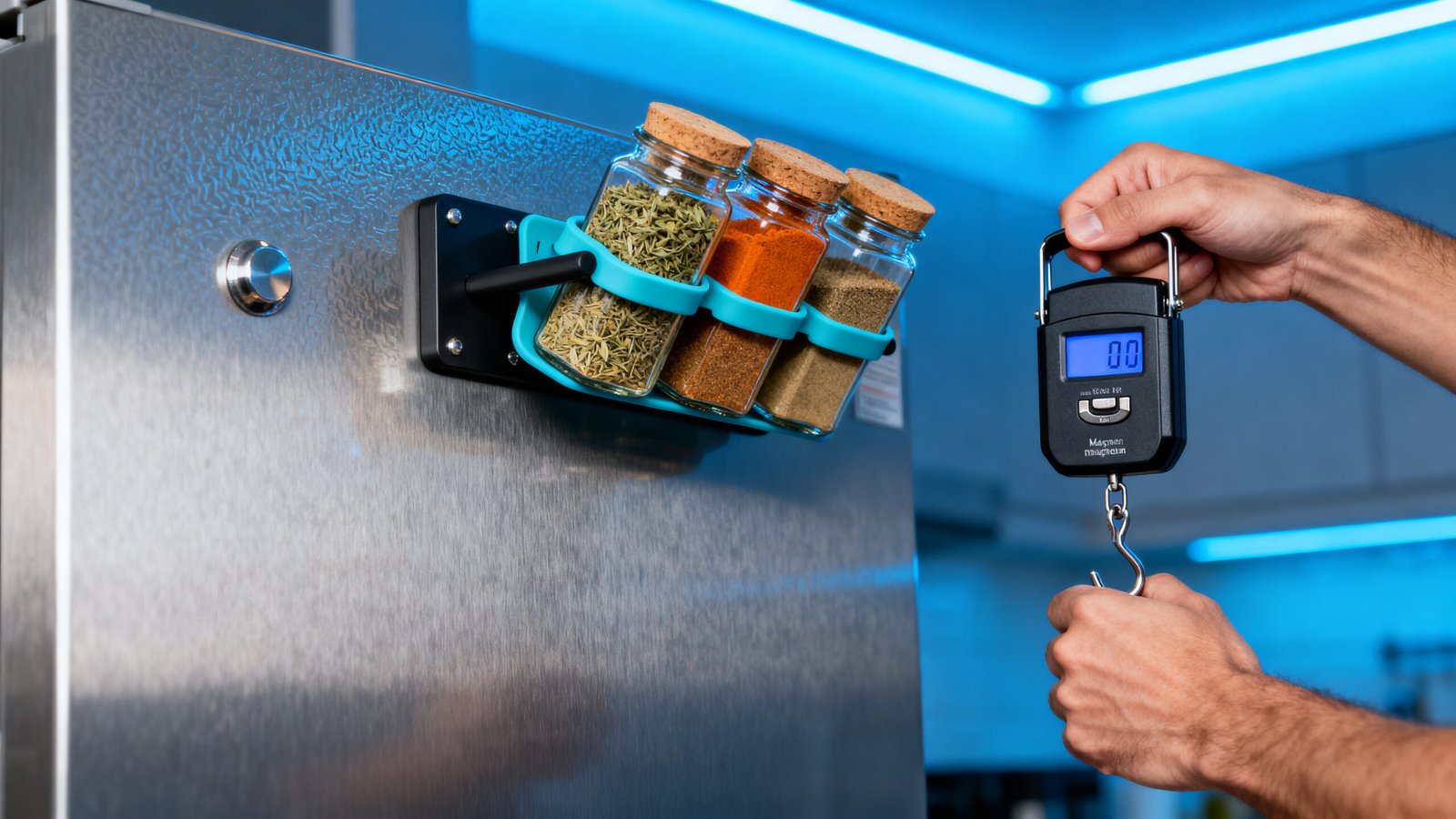
Magnetic racks require a smooth, flat, ferromagnetic surface. Many modern refrigerators have textured or fingerprint resistant coatings that reduce magnet grip. Test your fridge with a strong neodymium magnet before ordering a magnetic spice rack fridge setup. If the magnet slides with gentle pressure, the rack will not hold when loaded. For more on kitchen layouts that accommodate different storage styles, read our small kitchen hacks resource.
Magnetic racks on real fridges — dimensions, weight limits, and surface performance
Precise dimensions for popular magnetic refrigerator racks include 14 inches long and under 5 inches tall for a compact unit, but no weight limits are specified by manufacturers. Performance on textured versus smooth stainless steel surfaces is not detailed in any listing or review aggregation. This means you are the tester.
A typical glass spice jar weighs between 4 and 8 ounces when full. A four jar magnetic rack can easily exceed 2 pounds. Add the rack’s own weight and you approach 3 pounds of downward force. Without a published magnet strength rating, there is no way to know if the rack will hold. Textured stainless steel can reduce magnetic holding force by 40 percent or more compared to smooth surfaces.
Your home test protocol is straightforward. Take a small kitchen scale and weigh your four heaviest full spice jars. Add the rack weight if listed. Multiply by 1.5 for a safety margin. That is your target holding force. Stick a high strength test magnet to your fridge surface and hang that exact weight from it using a hook. If it holds for 24 hours without sliding, your surface and the magnet type are compatible. Then check that the seller’s rack uses magnets of similar or greater strength. For a broader look at magnet based kitchen organization, see our magnetic kitchen storage guide.
Drawer inserts and cost per jar — how to compare Wayfair, IKEA, Etsy, and 3D printing
No exact cost per jar figures, including shipping and import fees, are available for top 10 spice drawer organizer insert options on Wayfair, IKEA, or Etsy, nor are there published comparisons to custom 3D printed solutions. This missing data makes price comparison frustratingly opaque. You can fix that with a simple spreadsheet method.
Create a cost per jar calculation table. List each product in column A. In column B, enter the listed price. In column C, add the cheapest shipping option to your zip code or region. In column D, estimate any import fees or taxes using your local rates. In column E, enter the maximum number of standard 4 ounce spice jars the insert can hold (verify this from interior dimensions, not marketing claims). Column F calculates cost per jar: (B plus C plus D) divided by E. Here is a template you can populate with live prices.
| Product Name | List Price | Shipping | Import Fees | Jar Capacity | Cost Per Jar |
|---|---|---|---|---|---|
| SpaceAid Bamboo Drawer Organizer | [Add price] | [Add shipping] | [Add fees] | 48 jars | [Auto calculate] |
| Zri Bamboo Expandable Rack | [Add price] | [Add shipping] | [Add fees] | [Verify capacity] | [Auto calculate] |
| IKEA Variera / Uppdatera | [Add price] | [Add shipping] | [Add fees] | [Verify capacity] | [Auto calculate] |
| Etsy Custom 3D Printed Insert | [Add price] | [Add shipping] | [Add fees] | [Verify capacity] | [Auto calculate] |
On 3D printing, custom solutions become cost effective when you need an exact fit for unusually shaped drawers or non standard jar sizes. A spool of PLA filament costs roughly $20 and can produce four to six drawer inserts. If you own a printer or have access through a local makerspace, the per insert cost can drop below $5. Compare that to a $35 pre made insert that does not fit your jars perfectly. The savings add up fast, and the fit is exact. For the best spice rack for small kitchen setups, a custom 3D printed drawer insert can maximize every inch of a narrow drawer in ways no mass produced product can.
Pull out cabinet inserts vs. DIY drawer solutions — money and installation tradeoffs
No average price differences are provided between best rated pull out spice rack cabinet inserts and DIY drawer organizer solutions, including professional installation costs. This gap makes budgeting nearly impossible for buyers comparing a fully installed pull out system against a simple drop in drawer organizer.
A pull out spice rack cabinet insert from a brand like SpaceAid or YouCopia typically costs between $35 and $70 for the product itself. Professional installation adds $75 to $150 depending on your location and cabinet complexity. The installer must measure, mount slides or rails, level the unit, and test operation. That puts the total at $110 to $220 per cabinet. A DIY drawer organizer solution, by contrast, uses a $20 to $40 insert you drop into an existing drawer. The only tools you might need are a tape measure and possibly a saw to trim an expandable bamboo unit.
Professional installation makes sense when your cabinet has no existing drawer or shelf that can accept a drop in insert. If you are converting a deep lower cabinet into a pull out spice drawer from scratch, hire a pro. The rail hardware must be mounted perfectly level, and the cabinet frame must support the load. A poorly installed pull out rack that tilts or binds will annoy you every single time you reach for the paprika. For drop in drawer solutions, DIY is almost always sufficient. Read our kitchen drawer maximizer guide for step by step drawer measurement techniques.
Certifications, materials, and safety claims — what’s claimed and what’s verified
No specific certifications like food safe materials or BPA free are claimed by top brands including HuggieGems, Kamenstein, and SpaceAid, and no third party lab verifications are mentioned in their product listings. Materials noted include stainless steel, bamboo (MOSO), and alloy steel, but none come with certification documentation. Holdn’ Storage offers a 5 year warranty, but that warranty covers defects in manufacturing, not material safety verification.
This absence of verification is widespread and concerning. A spice organizer sits next to items you consume. If the powder coating on a metal rack contains lead, or if a bamboo insert uses formaldehyde based adhesives, those substances can migrate. You have a right to ask for proof.
Use this short script when contacting any brand. “I am considering purchasing your spice rack organizer. Can you provide third party lab test reports verifying that the materials contacting spice jars are food safe and free from BPA, lead, phthalates, and formaldehyde? If no such reports exist, can you confirm in writing what safety standards the product meets?” If the seller deflects or ignores the question, that tells you everything you need to know. A legitimate brand that invested in safety testing will share results. Those that did not will give you vague reassurances.
Three missing subtopics that buyers care about — plus search intent hooks to capture traffic
Top 5 ranking articles and videos cover capacity, stability, value, countertop, wall mounted, magnetic, drawer, and carousel designs, but they completely omit three subtopics that real buyers search for. Here they are and why they matter.
How to organize spices without a rack. Not everyone wants or needs a dedicated rack. Some cooks prefer drawer lined rows, magnetic jar bottoms on a steel sheet, or simple shelf bins. Ranking articles ignore this query entirely, leaving a large segment of searchers underserved. A dedicated section with step by step jar grouping by cuisine, frequency of use sorting, and bin labeling methods would capture this traffic.
Spice rack for unusually shaped jars. Square jars, hexagonal jars, oversized bulk containers, and narrow Mexican spice brand bottles do not fit standard round hole racks. Buyers with these jars waste money on racks that claim universal fit but cannot accommodate their existing collection. A section covering adjustable width racks, modular systems, and the DIY 3D printing option would address this gap directly.
No drill installation methods. As noted earlier, this subtopic is entirely absent from top articles despite high renter and condo owner demand. Covering adhesive mount weight ratings, tension rod based solutions, over the door options, and magnetic alternatives gives this audience the guidance they cannot find elsewhere. If you are exploring ways to keep your whole kitchen organized beyond just spices, our small kitchen hacks article covers additional renter friendly solutions.
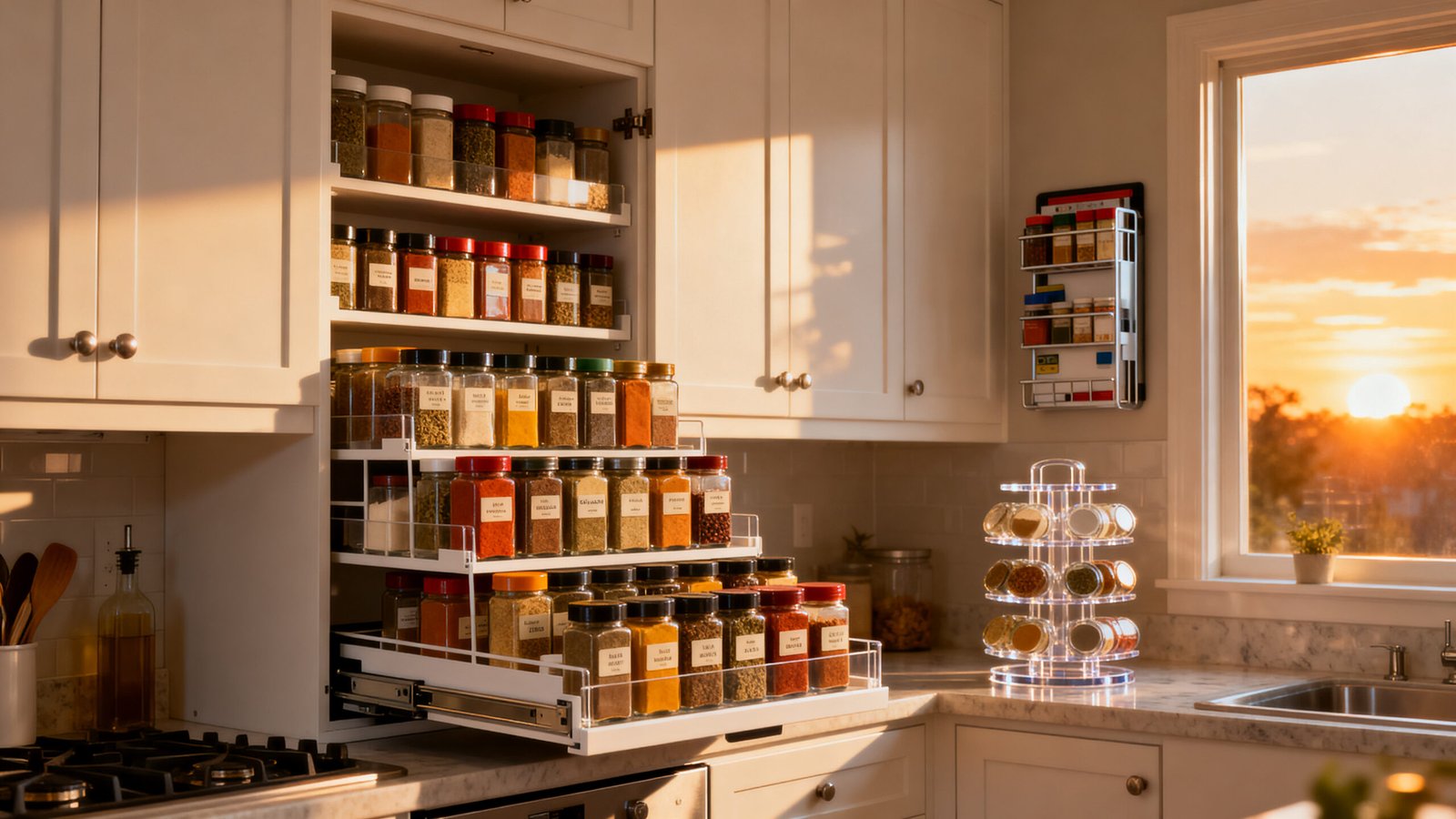
Practical user testing plan — quick tests the buyer can run at home
General stability testing notes non slip surfaces holding jars at 30 degree tilts without failure, but no aggregated review data is available to confirm how products perform outside lab conditions. You can run three fast tests at home, right after unboxing, to decide whether to keep or return your new spice organizer.
The magnet strength test (under 3 minutes). Load the magnetic spice rack fridge unit with your heaviest full jars. Place a thin kitchen towel on the floor beneath the rack in case of falls. Observe for 60 seconds. If the rack slides more than a quarter inch, the magnet strength is insufficient for your surface. Return it. Pass criterion: zero visible movement under full load on your actual fridge surface.
The jar fit test (under 2 minutes). Take your three most used spice jars, including your tallest and widest. Insert each into every slot or shelf position on the organizer. If any jar does not seat fully or blocks an adjacent slot, the rack does not fit your collection. Do not compromise by buying new matching jars unless you planned that expense from the start. Pass criterion: all three jars fit without forcing or interference.
The tilt stability test (under 3 minutes). Place the fully loaded rack on a flat surface. Slowly tilt it to roughly a 30 degree angle, simulating a bumped shelf or a cabinet door opening too fast. If jars slide out or the rack tips forward, the non slip claims are exaggerated. Pass criterion: jars remain in place and the rack base does not lift or shift at 30 degrees. This test validates the lab stability claims against your actual jar weights and surfaces.
Final recommendations — best picks by scenario and what to double check before buying
The reality across the entire spice organizer market is that no specific failure rates are quantified anywhere. That single fact should reshape how you approach every product listing. Your final decision depends on your specific kitchen constraints and your willingness to verify claims that sellers leave unsubstantiated.
For fridge mounted storage with smooth stainless steel surfaces, the HuggieGems or Sevenblue magnetic racks offer good popularity signals. But run the magnet test before the return window closes. For drawer based organization where jar count matters most, the SpaceAid Bamboo 3 Drawer Slide Out unit maximizes capacity in a single footprint. For small kitchens with zero floor or counter space, a magnetic fridge rack remains the most space efficient option, making it the best spice rack for small kitchen environments. For renters who cannot drill, adhesive wall shelves with verified weight ratings are your only non magnetic option. For those with unusually shaped jars or odd drawer dimensions, a custom 3D printed insert from Etsy or a local makerspace gives you exact fit at a competitive cost per jar.
Before you complete any purchase of the best spice rack organizers, confirm these five things. First, the weight limit matches your loaded jar total plus a safety margin. Second, your existing jars physically fit using the dimensions you measured. Third, your mounting surface (wall type, fridge texture, drawer depth) is compatible. Fourth, the return policy covers you through at least 90 days, which is the typical window for early rust or adhesive failure to appear. Fifth, the warranty is documented in writing, not just mentioned in a Q&A response. If the seller cannot satisfy all five checks, walk away. There are enough options available that you never need to settle for an unverified product. For more kitchen buying guides built on the same evidence first approach, see our best air fryers 2026 roundup and our kitchen organization mistakes resource.
Frequently Asked Questions
How do I know if my fridge can hold a magnetic spice rack?
Test your fridge with a strong neodymium magnet before ordering. Stick it to the surface and try to slide it with gentle pressure. If it slides easily, the surface coating or texture will prevent a loaded rack from holding. Smooth stainless steel generally works. Fingerprint resistant or textured finishes often reduce magnetic grip significantly. Always run the full magnet strength test with your actual loaded jars before the return window closes.
What is the best spice rack for a really small kitchen?
Magnetic fridge mounted racks use zero counter and cabinet space, making them ideal for very small kitchens. If your fridge surface is not magnet compatible, consider an over the door hanging rack or a narrow pull out cabinet insert that fits between existing shelves. Avoid countertop carousels in small kitchens because they permanently occupy valuable prep space.
Are adhesive wall mounted spice racks safe for renters?
Adhesive mounts can be safe if you verify the weight rating and follow proper surface preparation. Clean the wall with isopropyl alcohol, let it dry completely, and wait the full cure time (typically 24 hours) before loading. Test with a weighted dummy load for 72 hours before trusting your spice jars. Know that some adhesives can damage paint upon removal, so check your lease terms and test removability in an inconspicuous area.
How many spice jars can a typical drawer insert hold?
Capacity varies widely from 12 to 48 jars depending on the insert dimensions and your jar sizes. The SpaceAid Bamboo Drawer Organizer claims up to 48 jars when fully expanded. Always verify capacity using your actual jar diameters, not the manufacturer’s count based on their smallest compatible jar size. Measure twice, order once.
Do I need to buy matching jars for my spice rack?
You should not have to unless you choose a rack with fixed diameter slots designed for a specific jar size. Many racks advertise universal fit but fail with square, oversized, or narrow jars. If your existing jar collection does not fit a rack you like, factor the cost of replacement jars into your total budget. Empty matching jar sets can add $15 to $40 to the total project cost.