

Getting your first instant pot beginners guide right means the difference between a appliance you use weekly and one that collects dust in a cabinet. If you have just unboxed a 3, 6, or 8 quart model and feel that knot of nervousness in your stomach, you are in exactly the right place. This guide walks you through every single step, from the initial safety check to your first real meal, without overwhelming you with jargon or presets you do not need yet.
Key Takeaways
- Run a 5 minute water test before cooking any food to verify your unit works and to build confidence with the sealing and release process.
- The Manual or Pressure Cook button is all you need for nearly every recipe. Preset buttons are optional shortcuts, not requirements.
- Most first time failures trace back to three things: insufficient thin liquid, an improperly seated sealing ring, or forgetting to set the valve to Sealing.
- Quick Start: Unbox, Inspect, and Prepare for First Use
- The Water Test: Exact Steps, Water Amount, Timer, and Safe Release
- Instant Pot Buttons Explained: What Beginners Actually Need to Know
- First Time Fails and How to Prevent Them (Top Beginner Complaints)
- BURN Error: A Stepwise Troubleshooting Flow You Can Follow
- Fail Proof Beginner Recipes: Your First Real Meal (Exact Ingredients, Times, and Release)
- Converting Stovetop or Oven Recipes to the Instant Pot: Simple Rules of Thumb
- Pot in Pot (PIP) Cooking: Step by Step Examples (Rice and Main)
- Accessories That Actually Help Beginners (What to Buy and Why)
- Cleaning, Maintenance and Odor Removal: Keep It Working and Smelling Fresh
- Adjusting Recipes for Different Pot Sizes (3 qt, 6 qt, 8 qt)
- Quick Troubleshooting Cheat Sheet and One Page FAQ (Printable)
- Final Pre Meal Checklist: What to Verify Every Time
Quick Start: Unbox, Inspect, and Prepare for First Use
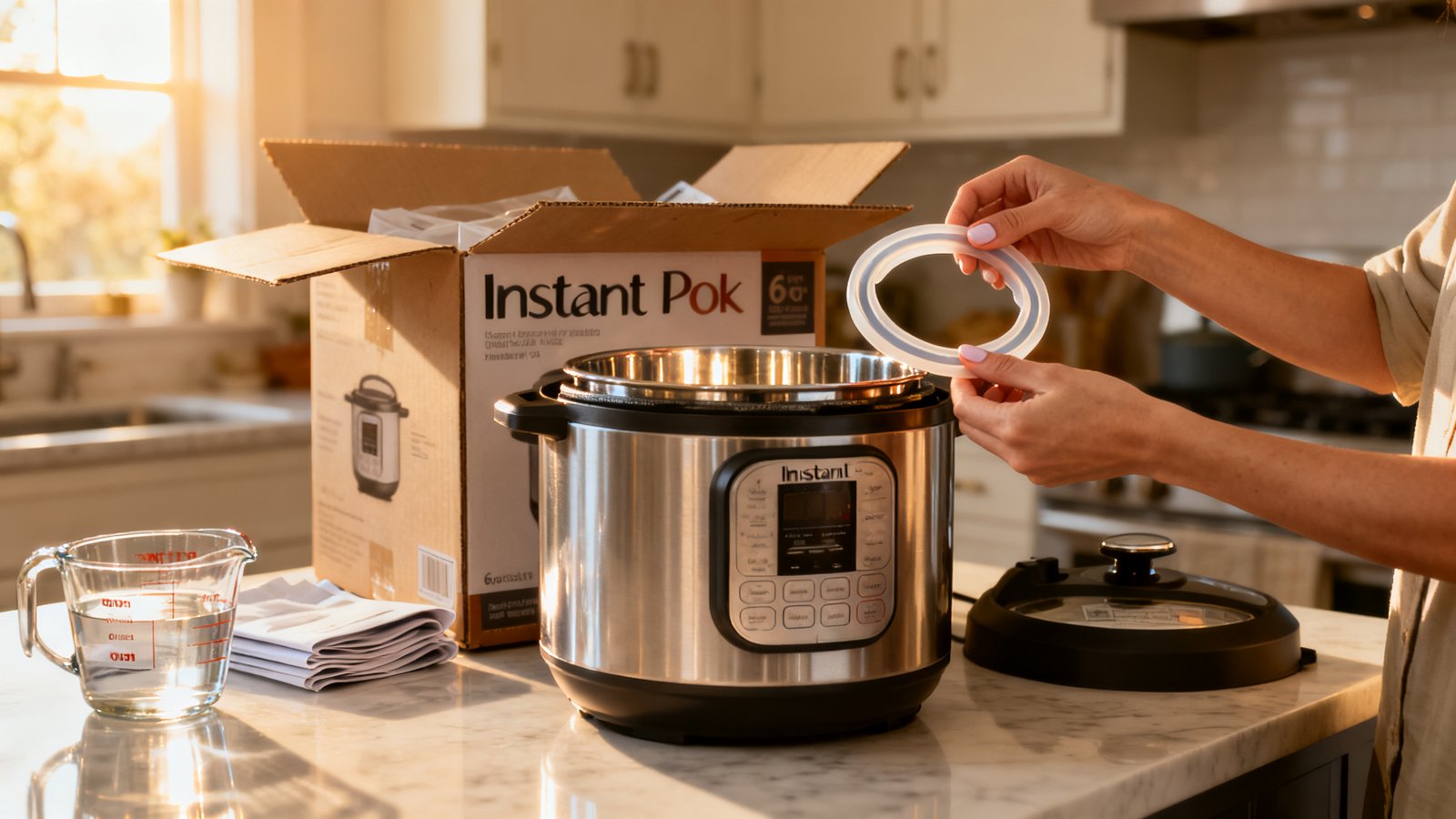
Before you plug anything in, take ten minutes to inspect your new Instant Pot. This is not busywork. Missing one of these checks is the root cause behind most “my Instant Pot does not work” complaints you will find in user reviews across the web.
First, lift the stainless steel inner pot out and confirm it is present and undamaged. Operating the cooker without the inner pot in place can permanently damage the heating element, according to detailed guides on pressure cooking safety. Set it back inside the housing and press down gently to ensure it sits flush against the heating plate.
Next, examine the lid. The silicone sealing ring must be seated evenly in its groove with no bulges, twists, or gaps. Run your finger along the entire circumference. A poorly seated ring lets steam escape around the lid edge, and your pot will never reach pressure. While you are there, check the float valve (the small metal pin) and the steam vent. Both must move freely and have no debris blocking them.
Finally, place your Instant Pot on a clear counter where steam can vent upward without hitting cabinets, walls, or your gas stove. The steam plume during a quick release is forceful and hot. Give it at least 12 inches of clearance above and around the vent. Plug the unit in. You will hear a beep. That is normal. The display shows OFF. Also normal. You are ready for the water test.
The Water Test: Exact Steps, Water Amount, Timer, and Safe Release
The water test is your universal first recipe. It cannot burn. It cannot undercook. It verifies that your unit seals, pressurizes, cooks, and releases correctly before you risk any food. Every reputable Instant Pot resource, from Pressure Cook Recipes to Devour Dinner, recommends this as the starting point.
Pour 2 cups (about 500 ml) of cold water into the inner pot. Some guides use 1 cup and that works too. Two cups gives you a bit more steam to observe during release, which is helpful for learning. Place the lid on and turn it clockwise until you hear the locking chime. The lid should be fully closed with no wiggle.
Now turn the steam release handle to the Sealing position. This is the single most common mistake beginners make: leaving it on Venting and then wondering why the pot never pressurizes. Push it firmly until it points to Sealing.
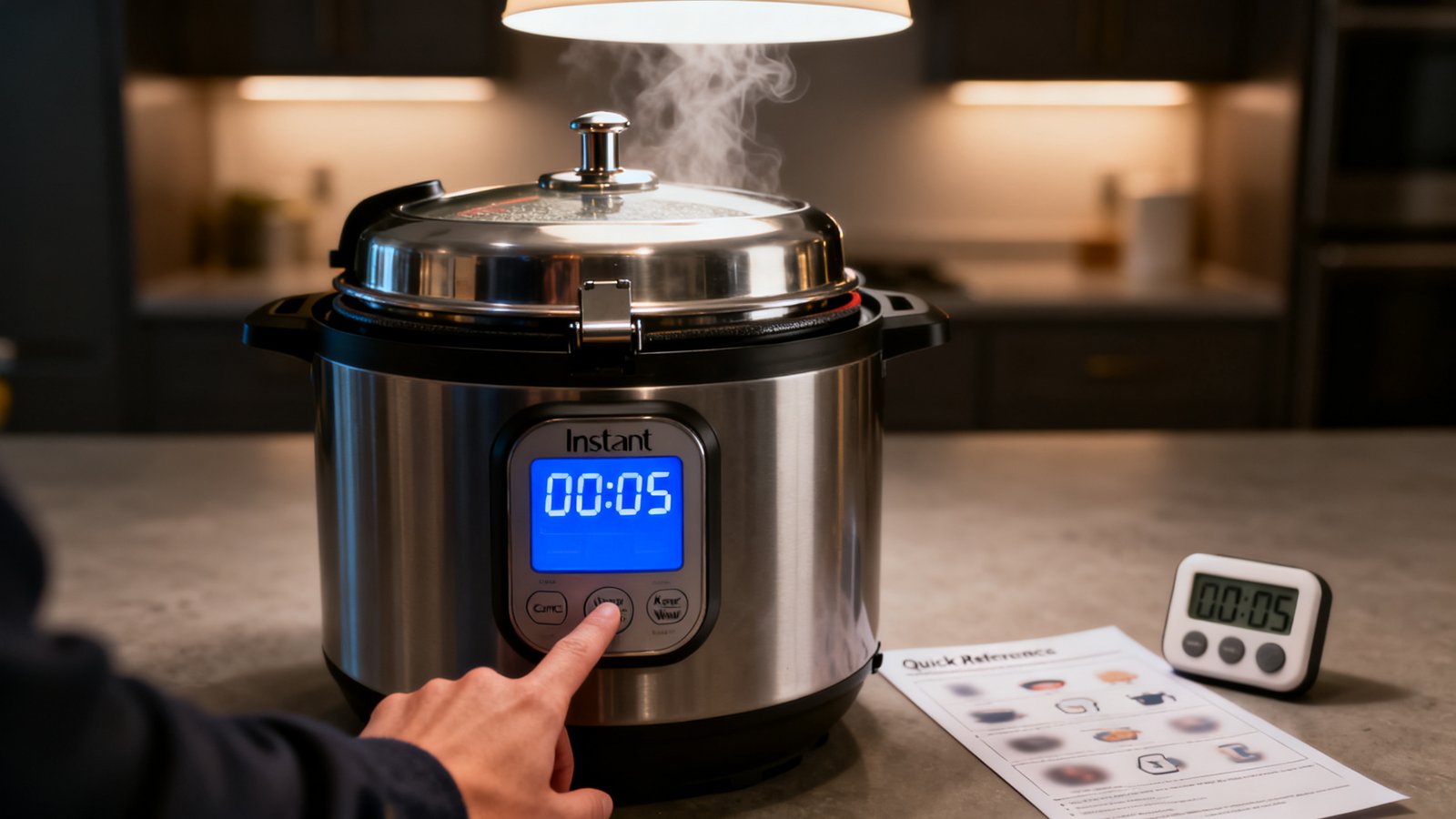
Once you press start, the display will show On for several minutes while the pot heats and builds pressure. The float valve (the silver pin next to the steam release) will rise. When full pressure is reached, the timer begins counting down from 5 minutes. You will hear a gentle hiss occasionally. That is the unit regulating pressure. Totally normal.
When the timer hits zero and beeps, press Cancel. This stops the automatic Keep Warm function from kicking in and prolonging the steam release. Now, using a long handled wooden spoon or keeping your hand well to the side, turn the steam release handle to Venting. A powerful jet of steam will shoot upward. Keep your face and hands away. Once the float valve drops back down, the lid will unlock. Open it away from you. If the water is hot and the unit completed the cycle, your Instant Pot works perfectly. Confidence unlocked.
Instant Pot Buttons Explained: What Beginners Actually Need to Know
The control panel looks like a cockpit at first glance. Soup, Meat/Stew, Bean/Chili, Rice, Multigrain, Porridge, Steam, Slow Cook, Yogurt. It is a lot. The secret that experienced users know is that you can ignore nearly all of them.
On older models, the button you want is labeled Manual. On newer models, it is labeled Pressure Cook. Both do exactly the same thing, as confirmed by detailed beginner guides. They let you set a custom cook time and pressure level. Almost every recipe you will ever follow calls for Manual or Pressure Cook on High pressure. The preset buttons are simply automatic versions of this same function with preprogrammed times. Rice is 12 minutes at low pressure. Soup is 15 minutes at high pressure. You can achieve identical results by selecting Manual and setting those times yourself.
The Sauté button heats the inner pot without the lid, exactly like a stovetop pan. Use it to brown meat, soften onions, or simmer sauces before pressure cooking. Press the Adjust button while in Sauté mode to toggle between Less (gentle simmer), Normal (standard browning), and More (high heat searing). After sautéing, always press Cancel before switching to Pressure Cook. This clears the sauté mode and prevents error messages.
The Keep Warm/Cancel button serves double duty. Pressing it once during any active program cancels that program immediately. After a cook cycle finishes, the unit automatically enters Keep Warm mode. The display shows an elapsed timer counting up. If you plan to do a quick release, press Cancel first to turn off Keep Warm. This shortens the steam release time significantly.
Pressure Level or Adjust (depending on your model) toggles between High and Low pressure when you are in Manual or Pressure Cook mode. High is 10.2 to 11.6 psi. Low is 5.8 to 7.2 psi. Nearly every recipe assumes High pressure unless specified otherwise.
First Time Fails and How to Prevent Them (Top Beginner Complaints)
Understanding what trips up other beginners helps you sidestep the same frustrations. Research and user comment analysis from multiple sources reveals a consistent pattern of complaints.
The number one sentiment expressed by new owners is fear. Many people leave the Instant Pot in the box for weeks or months because the pressure scares them, as noted by beginner focused guides. The water test directly addresses this. Once you see the process work with just water, the fear diminishes substantially.
Another frequent complaint is that the steam release seems to go on forever. This happens when Keep Warm is active during venting. Pressing Cancel before turning the valve to Venting solves this. The steam stops much faster when the heating element is not working against the release.
Steam leaking around the lid edge is almost always a sealing ring issue. The ring may not be fully pushed into its groove, or it may have a small bulge. Removing and reseating it fixes the problem in most cases. Occasionally, a new ring needs a brief soak in warm water to become more pliable and seat correctly.
Some users report the pot never reaches pressure. The culprit is usually the steam release handle left on Venting, or the float valve being stuck. Check both before every cook. If the float valve does not rise after 15 to 20 minutes of heating, something is preventing a seal.
Other complaints include the lack of a dedicated cancel method on certain off brand models and confusion about the front panel after a cook finishes. On a genuine Instant Pot, Cancel always works. If your display is frozen or unresponsive, unplugging the unit for 30 seconds and plugging it back in resets the control board safely.
BURN Error: A Stepwise Troubleshooting Flow You Can Follow
The BURN message is the most common error beginners encounter. It appears when the temperature sensor on the bottom of the inner pot detects overheating, typically from food sticking and scorching. This is not a catastrophic failure. It is a protective feature, and it is almost always fixable.
Start with the simplest check. Did you add enough thin liquid? Water, broth, or a watery sauce must be present. The Instant Pot requires at least 1 cup of thin liquid for a 6 quart model to build steam. Thick sauces like barbecue sauce or cream based mixtures do not count as thin liquid and will trigger the BURN message quickly.
Next, if you used the Sauté function before pressure cooking, did you deglaze the pot? Browning meat or vegetables leaves a fond, a layer of caramelized bits on the bottom. Adding a splash of broth or water and scraping the bottom with a wooden spatula before pressure cooking lifts those bits and prevents scorching. Skipping this step is one of the most reliable ways to trigger a BURN error.
Check that the sealing ring is seated properly and the float valve moves freely. A steam leak from a poorly seated ring causes liquid to evaporate faster than expected, concentrating solids on the bottom and triggering the sensor. Also, avoid layering thick ingredients like tomato paste or heavy starches directly on the bottom of the pot. If your recipe includes these, add them on top of other ingredients or stir them into the liquid thoroughly before starting the cook cycle.
If the BURN message appears mid cook, press Cancel immediately. Open the lid carefully (using quick release if the unit has pressurized at all), add half a cup of water or broth, scrape the bottom to release any stuck bits, reseal the lid, and restart the cycle. In most cases, this resolves the issue.
Fail Proof Beginner Recipes: Your First Real Meal (Exact Ingredients, Times, and Release)
You have completed the water test. Your unit works. Now you want to cook actual food. Here are two guaranteed recipes with precise measurements so there is no guesswork. Both are widely recommended in pressure cooking communities but rarely presented with complete step by step instructions in beginner guides.
3 Ingredient Shredded Chicken
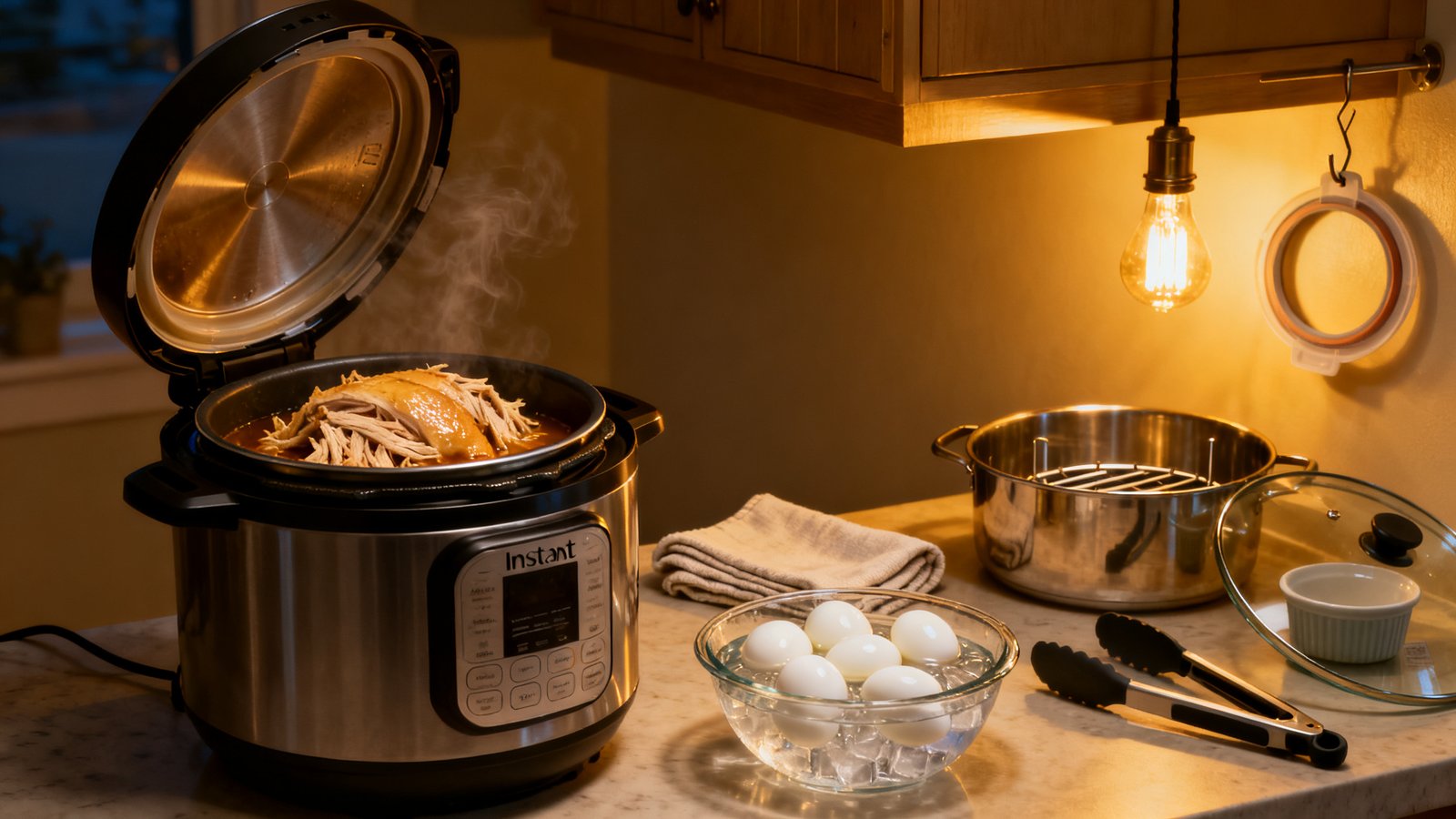
Place 1.5 pounds (about 680 grams) of boneless, skinless chicken breasts in the inner pot. Add 1 cup of chicken broth or water. Sprinkle 1 teaspoon of salt evenly over the top. That is it. Three ingredients. Lock the lid, set the valve to Sealing, and select Manual or Pressure Cook on High for 10 minutes. When the timer beeps, let the pressure release naturally for 5 minutes (do not touch anything), then carefully turn the valve to Venting for a quick release of any remaining steam. Open the lid, transfer the chicken to a bowl, and shred with two forks. Use this chicken for tacos, sandwiches, salads, or meal prep. It is nearly impossible to mess up.
Hard Boiled Eggs: The 5 5 5 Method
Place a trivet in the inner pot and add 1 cup of water. Arrange up to 6 eggs on the trivet. Lock the lid, set the valve to Sealing, and select Manual or Pressure Cook on High for 5 minutes. When the timer beeps, allow a 5 minute natural release (do nothing for 5 minutes after the beep). Then perform a quick release and immediately transfer the eggs to an ice bath (a bowl of cold water with ice cubes). Let them sit for 5 minutes before peeling. The shells will slip off, and the yolks will be perfectly yellow with no green ring. This method is so reliable it has near legendary status among Instant Pot users.
While these recipes are simple, having the right tools in your kitchen makes the process even smoother. Just like choosing the best blenders under 100 dollars can transform your smoothie routine, mastering these basic Instant Pot recipes will transform your weeknight cooking.
Converting Stovetop or Oven Recipes to the Instant Pot: Simple Rules of Thumb
One of the biggest gaps in existing beginner guides is explaining how to adapt traditional recipes for pressure cooking. If you have a favorite stovetop stew or braise, you can convert it using a few consistent rules.
Liquid is the most important variable. Pressure cooking evaporates almost no liquid, unlike stovetop simmering. For soups and stews, reduce the liquid by roughly half of what the original recipe calls for. You can always add more after cooking if the consistency is too thick. For recipes that rely on reduction for flavor concentration, plan to simmer the dish using the Sauté function after pressure cooking to thicken it.
Timing is the second adjustment. As a rough starting point, pressure cooking takes about one third of the stovetop cooking time for most meats and legumes. A beef stew that simmers for 2 hours on the stove typically needs 35 to 40 minutes at high pressure. Dried beans that soak and simmer for 2 hours may cook in 25 to 30 minutes unsoaked.
When adapting oven recipes like braised short ribs or pot roast, use the Sauté function first to brown the meat directly in the pot, then add liquid and pressure cook. After the pressure cycle, if the sauce needs thickening, remove the meat, press Sauté, and reduce the liquid or stir in a cornstarch slurry. This workflow mirrors the stovetop to oven transition but happens entirely in one pot.
If you enjoy kitchen experimentation, you might also appreciate learning how to organize your spices with the best spice rack organizers so your converted recipes are properly seasoned every time.
Pot in Pot (PIP) Cooking: Step by Step Examples (Rice and Main)
Pot in Pot cooking lets you prepare two dishes simultaneously by placing a second container on a trivet above the main dish in the inner pot. The steam that cooks the food below also cooks the food in the elevated container. It is efficient and saves cleanup, but beginner guides rarely explain it with actionable examples.
To cook rice and a main dish together, place your main (for example, the shredded chicken from the recipe above with its broth) in the inner pot. Place a trivet over the meat. In an oven safe bowl that fits inside your Instant Pot, combine 1 cup of rinsed white rice with 1 cup of water. Set the bowl on the trivet. Lock the lid, seal, and cook on Manual High for the time required by the longer cooking item. In this case, the chicken needs 10 minutes and the rice also needs about 10 minutes at high pressure plus natural release. They finish together.
For PIP cooking to work, the bowl must be heat safe (stainless steel, tempered glass, or oven safe ceramic). The trivet must elevate the bowl above the liquid in the inner pot. Never fill the inner pot above the halfway mark when using PIP, as the displacement from the bowl raises the effective fill level. Always use a natural release when cooking grains PIP to prevent starchy liquid from foaming up through the steam vent.
Accessories That Actually Help Beginners (What to Buy and Why)
Your Instant Pot works right out of the box with nothing extra. But a few inexpensive accessories make it significantly more versatile. Existing guides rarely provide a curated list, so here is what actually earns its spot in your drawer.
An extra inner pot is the most practical purchase. With two pots, you can cook rice in one and a curry in the other without washing in between. Stainless steel replacements are affordable and fit the same lid. An extra sealing ring is equally useful. Silicone rings absorb odors from savory dishes, and having a dedicated ring for yogurt or cheesecake prevents flavor transfer. Many users label one ring for savory and one for sweet.
A set of stacking trivets or a collapsible steamer basket expands what you can cook. Hard boiled eggs, steamed vegetables, and PIP meals all require elevation above the water. A tempered glass lid lets you use the inner pot as a serving dish or for storage in the refrigerator after cooking. The standard pressure lid cannot go in the fridge. Silicone mitts or mini tongs designed for lifting the hot inner pot safely are also worth considering, especially if you plan to cook multiple dishes back to back.
Budget conscious cooks will appreciate that organizing a small kitchen efficiently is half the battle. Reading about how to organize a small kitchen on a budget can help you find space for these new accessories without cluttering your counters.
Cleaning, Maintenance and Odor Removal: Keep It Working and Smelling Fresh
Detailed cleaning instructions are surprisingly absent from most beginner guides. Yet the way you maintain your Instant Pot directly affects its longevity and the taste of your food.
After every use, wash the inner pot with warm soapy water. It is dishwasher safe, but hand washing preserves the finish. Remove the sealing ring from the lid and wash it separately. Silicone absorbs odors aggressively. If your ring smells like last night’s curry, soak it in a solution of equal parts water and white vinegar for 30 minutes, then air dry it completely. Some users also bake the ring at 300 degrees Fahrenheit for 20 minutes to eliminate stubborn odors, though airing it out in direct sunlight works nearly as well.
The anti block shield, the small metal or plastic cover on the underside of the lid near the steam vent, needs periodic removal and cleaning. Food particles can clog it and affect pressure regulation. Twist or pop it off (check your model’s manual), rinse it, and snap it back into place. The steam release handle also detaches on most models. Pull it straight up and wash the stem and housing to remove any buildup.
Wipe down the exterior housing and the rim where the lid seals with a damp cloth. Never submerge the housing in water. Store the lid upside down on the pot so the sealing ring does not compress permanently. A compressed ring loses its ability to seal effectively. Keeping your kitchen drawers organized with the best drawer organizers for your kitchen can also help you store small Instant Pot accessories like extra rings and trivets neatly.
Adjusting Recipes for Different Pot Sizes (3 qt, 6 qt, 8 qt)
Most recipes are written for the 6 quart Instant Pot, which is the most common size. If you own a 3 quart or 8 quart model, you need to make adjustments. Failing to do so leads to BURN errors, undercooked food, or overflowing disasters.
The minimum liquid requirement changes with pot size. A 3 quart model needs roughly half a cup of thin liquid to pressurize. A 6 quart needs 1 cup. An 8 quart needs about 1.5 cups. These are minimums. Many recipes include more liquid than the minimum, which is fine, but never go below these thresholds.
The maximum fill level also differs. For non foaming foods like meats and vegetables, never fill past the two thirds line marked on the inner pot. For foaming foods like beans, grains, and pasta, never fill past the half line. These markings are on every Instant Pot inner pot regardless of size. The 3 quart reaches its limits faster with smaller batches, while the 8 quart can accommodate double batches of most 6 quart recipes provided you do not exceed the max fill lines.
When scaling a 6 quart recipe down for a 3 quart, halve all ingredients but keep the cook time the same. Pressure cooking time depends on the thickness and density of the food, not the total volume. When scaling up for an 8 quart, you can usually double ingredients without changing the cook time, but the pot will take longer to come to pressure because of the larger thermal mass. That extra preheat time is normal and does not indicate a problem.
For PIP containers, a 3 quart pot fits smaller bowls (2 to 3 cup capacity). An 8 quart pot accommodates larger stackable containers. Measure your bowl diameter against your inner pot before committing to a PIP setup. The bowl must sit on the trivet without touching the sides of the pot.
Quick Troubleshooting Cheat Sheet and One Page FAQ (Printable)
Bookmark this section or print it. When something goes wrong mid cook, you need answers fast, not a 20 minute search through a manual.
| Problem | Likely Cause | Fix |
|---|---|---|
| Pot does not pressurize | Steam release set to Venting or sealing ring not seated | Flip valve to Sealing. Reseat the ring. Check float valve moves freely. |
| Steam leaks around lid | Sealing ring bulging or dirty | Remove ring, clean it, soak in warm water, reseat firmly. |
| BURN message appears | Insufficient thin liquid or stuck food on bottom | Add 1/2 cup water, deglaze bottom, restart. Avoid thick sauces on bottom. |
| Cannot cancel program | Display frozen or wrong button pressed | Press and hold Cancel for 3 seconds. If unresponsive, unplug for 30 seconds. |
| Long steam release time | Keep Warm active during release | Press Cancel before turning valve to Venting. |
Final Pre Meal Checklist: What to Verify Every Time
Before you start any cook, run through this mental list. It takes 30 seconds and prevents nearly every common failure. Confirm the inner pot is inside the housing. Check that you have added at least the minimum liquid for your pot size. Verify the sealing ring is seated evenly with no bulges. Ensure the float valve moves freely and the steam vent is clear. Set the steam release handle to Sealing. Confirm you have selected Manual or Pressure Cook on High pressure with the correct time. Plug the unit in and listen for the startup beep. If you are still building confidence, run the 5 minute water test as your very first cook. It is the universally recommended starting point and costs you nothing but five minutes of time.
Conclusion
Your Instant Pot is not a mysterious device that requires culinary school training. It is a tool, and like any tool, it responds to a few consistent rules. You now know how to inspect it, run a water test, navigate the buttons that actually matter, prevent the BURN error, cook two fail proof recipes, convert traditional dishes, and maintain the unit so it lasts for years. The single most important step is the first one. Fill it with two cups of water, set it for 5 minutes on High, and prove to yourself that it works. That one action turns fear into familiarity. This instant pot beginners guide gives you everything you need to start cooking tonight with zero anxiety and total confidence. If you found this guide helpful, you might also enjoy our comparison of the Ninja vs Cosori air fryer to round out your countertop appliance knowledge. Now go run that water test and cook something delicious.
Frequently Asked Questions
What is the first thing I should do with my new Instant Pot?
Run a water test. Pour 2 cups of cold water into the inner pot, lock the lid, set the valve to Sealing, and pressure cook on High for 5 minutes. Then perform a quick release. This verifies your unit works correctly and teaches you the sealing and release process without risking any food.
How much water do I use for the Instant Pot water test?
Most guides recommend between 1 and 3 cups of cold water. Two cups (about 500 ml) is a reliable middle ground that provides enough steam for you to observe the release process while keeping the preheat time reasonable.
Why does my Instant Pot keep saying BURN?
The BURN message appears when the bottom of the inner pot overheats. The most common causes are insufficient thin liquid, thick sauces sitting directly on the bottom, or food residue left after sautéing without deglazing. Add more water or broth, scrape the bottom clean, and restart.
Can I use the preset buttons or should I always use Manual or Pressure Cook?
You can always use Manual or Pressure Cook instead of any preset. The presets are simply automatic programs with pre set times and pressure levels. Manual gives you full control and is called Pressure Cook on newer models. Both function identically.
How do I safely release pressure from my Instant Pot?
Press Cancel first to stop the Keep Warm function. Then use a long handled spoon or keep your hand to the side and turn the steam release valve to Venting. Keep your face and hands away from the hot steam jet. Once the float valve drops, the lid unlocks and can be opened safely.