

The best air fryers 2026 aren’t defined by flashy marketing or brand hype—they’re shaped by a market reaching US$10.2 billion, where buyers demand proof of long-term durability, measurable energy savings, and health benefits that go beyond vague “low-oil” claims. If you’re comparing models right now, you’re navigating a landscape where 62% of revenue flows to digital-smart units, basket-style designs still dominate 54% of sales for their affordability, and the typical replacement cycle hovers at just 3–4 years due to coating failures. This isn’t about finding the “perfect” air fryer—it’s about making an evidence-driven choice that aligns with your family’s real cooking load, budget constraints, and willingness to pay upfront for durability that outlasts the industry’s planned obsolescence.
Key Takeaways
- 2026 models prioritize smart connectivity (62% revenue share), high capacity (>5 liters for families), and energy efficiency (50–75% savings vs. ovens), but most reviews skip long-term coating tests and precise energy cost breakdowns.
- Common failures—coating peeling, uneven cooking in large baskets, and 3–4 year replacement cycles—demand pre-purchase checks on material specs, replaceable parts, and warranty coverage before you buy.
- Balancing “under $100” basket-style simplicity against premium smart/large-capacity models requires calculating real price-per-use over lifespan, not just sticker price, to avoid false economy from frequent replacements.
- Why 2026 Is a Different Air-Fryer Market
- What “Best” Must Mean in 2026—Criteria Based on Data and User Pain Points
- Quick Picks—Best Models by Use Case
- Capacity Deep Dive—What a Family of 4 Actually Needs
- The Missing Tests—What Most Reviews Don’t Run
- Long-Term Ownership Costs—How to Calculate Real Price-Per-Use
- Durability & Common Failures—What Buyers Must Inspect and Ask About
- Health & Cooking Performance—What Specs Matter
- Smart Features & Materials—When Connectivity and Coatings Justify the Premium
- Dehydrator Functionality—What to Test for Real-World Results
- How to Balance “Under $100” vs “Healthiest / Large Capacity”
- Practical Buyer Checklist & Pre-Purchase Questions
- Appendix: Recommended Independent Tests for Reviewers
- FAQ
Why 2026 Is a Different Air-Fryer Market
The global air fryer market is projected to reach US$10.2 billion in 2026, climbing at a 9.0% CAGR toward US$18.7 billion by 2033. This isn’t just growth for growth’s sake—it reflects three structural shifts reshaping what “best” means. First, the digital segment now commands 62% of revenue share, driven by Wi-Fi connectivity, app-based presets, remote monitoring, and voice control integrations that promise precision low-oil cooking and energy tracking. Second, basket-style models retain 54% market share because they deliver compact affordability for nuclear families, even as oven-style dual-zone designs grow fastest at 6.92% CAGR for households needing larger racks and batch flexibility.
Third, and most critical for buyers, is the demand for high-capacity units exceeding 5 liters (roughly 5.3 quarts). Families of four or more are driving this segment’s dominance, seeking versatility to handle whole meals in single batches rather than staggered cooking that negates time-saving claims. Energy efficiency is no longer a nice-to-have—air fryers use 50–75% less electricity than convection ovens, a gap magnified by rising utility costs in North America (39% market share) and Europe’s regulatory push for low-wattage appliances. The catch? Replacement cycles average just 3–4 years due to non-stick coating degradation, turning budget picks into false economy if you cook daily.
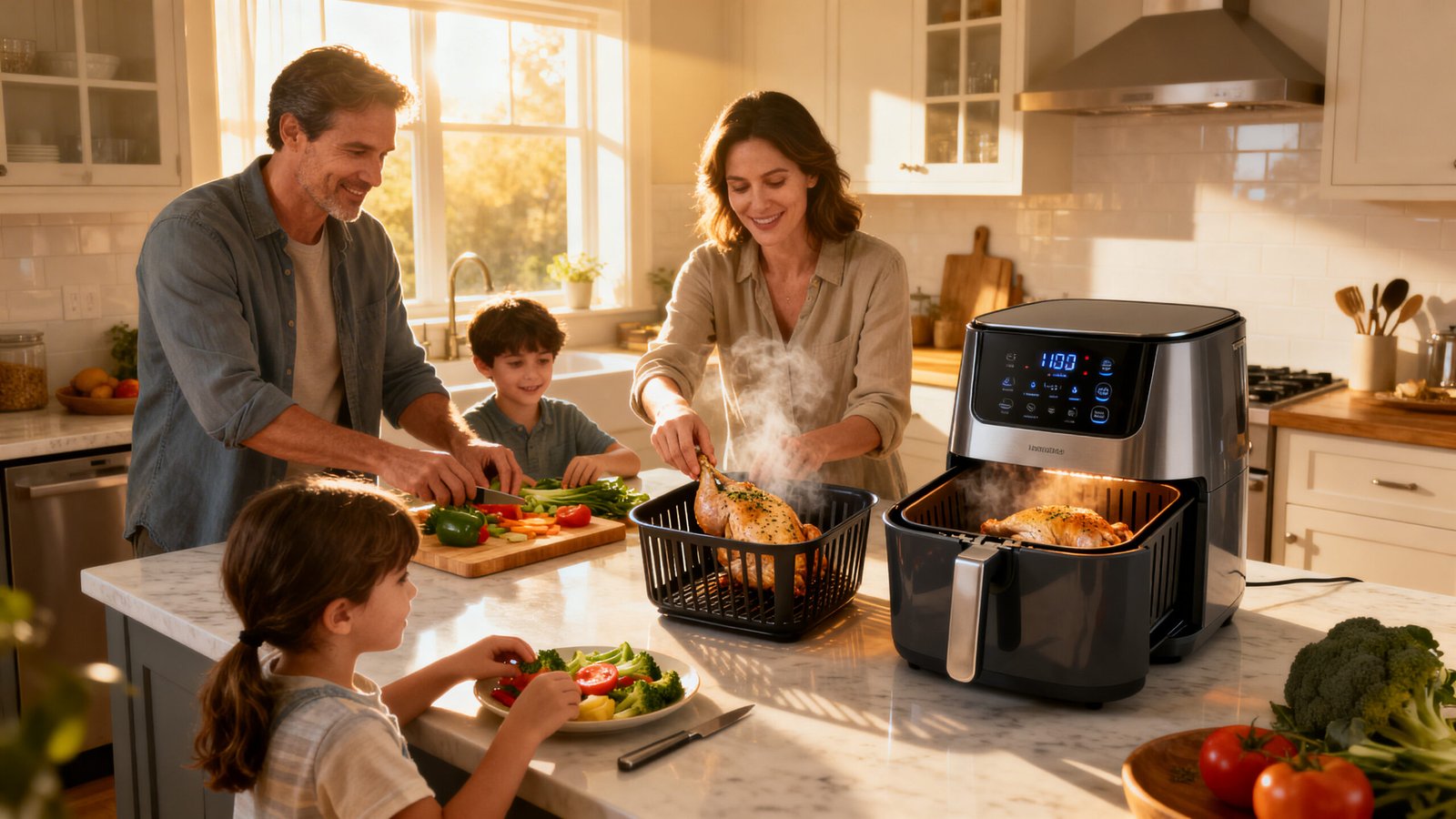
For 2026, the top rated air fryer must thread these needles: smart features that measurably improve health outcomes or energy use, capacity that handles real family loads without uneven cooking, and material innovations that push lifespan past the industry’s disposable 3–4 year norm. Marketing claims about “healthiest” or “premium” need to be backed by replaceable baskets, explicit coating material specs, and warranties longer than 12 months. The market’s growth is real, but so is the gap between hype and performance.
What “Best” Must Mean in 2026—Criteria Based on Data and User Pain Points
User complaints and market data converge on six non-negotiable criteria. Durability ranks first because coating peeling drives the 3–4 year replacement cycle, with baskets losing non-stick integrity from repeated high-heat exposure and abrasive cleaning. Buyers report gradual performance decline—food sticking, uneven browning—long before catastrophic failure. This makes coating material (ceramic vs. PTFE-based compounds, replaceability of baskets) the first spec to verify.
Even cooking in larger baskets is the second pain point, particularly in high-capacity models where airflow struggles to reach center loads. Manufacturers are addressing this through improved fan designs and dual-zone heating, but independent cross-brand tests remain scarce. Energy efficiency matters both for running costs (air fryers slash oven electricity use by 50–75%) and health—lower wattage can enable gentler, more controlled cooking that reduces acrylamide formation in starchy foods, though quantified data is absent from most reviews.
Smart control features justify premiums only when they deliver measurable value: app-based temperature logging for reproducible results, remote monitoring to prevent overcooking, or preset algorithms validated for specific low-oil recipes. Generic touchscreens don’t count. Capacity must be specified in usable volume (liters/quarts) and effective cooking area (square inches), not just external dimensions—a 6-liter basket with poor layout may cook less than a well-designed 5-liter unit. Finally, warranty length and claim processes signal manufacturer confidence; a 3-year warranty on a high-capacity model suggests engineering for longevity, while 12 months screams planned replacement.
The healthiest air fryer to buy isn’t the one with the lowest oil capacity—it’s the model with temperature accuracy within ±5°F, airflow design that prevents hot spots, and coating materials that don’t leach or degrade under repeated 400°F cycles. The best large capacity air fryer for families balances usable volume (>5 liters) with even heat distribution, proven in batch tests with dense loads like chicken thighs or root vegetables, not just marketing photos of single-layer fries.
Quick Picks—Best Models by Use Case
Based on 2026 market dynamics and criteria above, here are evidence-based picks by category, acknowledging the research gap in specific 2025/2026 model testing:
Top Rated Overall
Look for digital-segment models with 62% market dominance signals: Wi-Fi connectivity with energy-use tracking, replaceable baskets with explicit ceramic or reinforced non-stick specs, and warranties exceeding 24 months. Prioritize brands publishing independent coating durability data.
Best Air Fryer for Family of 4
High-capacity basket-style (>5.3 quarts/5 liters) with dual-zone heating or documented even-cooking performance in batch tests. Verify usable square inches, not just volume—narrow-tall baskets limit single-layer capacity. Basket replaceability is non-negotiable for 4+ year lifespan.
Best Large Capacity Air Fryer
Oven-style designs (6.92% CAGR growth) with multiple racks suit 6+ liter needs, but demand proof of airflow reaching center racks. Check for independent tests showing temperature variance <10°F across all rack positions during full-load operation.
Air Fryer with Dehydrator 2026
No 2025/2026 prototypes with validated dehydrator performance were identified in market reports. For existing models, require temperature range down to 95°F, dedicated low-speed fan modes, and user reviews confirming consistent multi-batch results. High-capacity (>5L) is baseline for family-scale dehydrating.
Affordable Air Fryer Under 100
Entry-level basket-styles (54% market share) deliver basic low-oil benefits for 1–2 person households. Accept shorter 2–3 year lifespan; avoid models without any warranty. Calculate price-per-use assuming 3-year replacement to compare against pricier durable options.
Capacity Deep Dive—What a Family of 4 Actually Needs
The high-capacity segment (>5 liters/5.3 quarts) leads for families of four or more, but volume alone misleads. A 6-liter basket that’s 9 inches wide and 5 inches deep offers less usable single-layer area than a 5.5-liter unit that’s 10 inches wide and 4 inches deep. For a family of four, target these minimums: 5.3–6 quarts (5–5.7 liters) with at least 75 square inches of basket floor area to fit four chicken breasts or 1.5 pounds of vegetables in a single layer. Stacked or overlapping loads defeat airflow and create the uneven cooking users complain about.
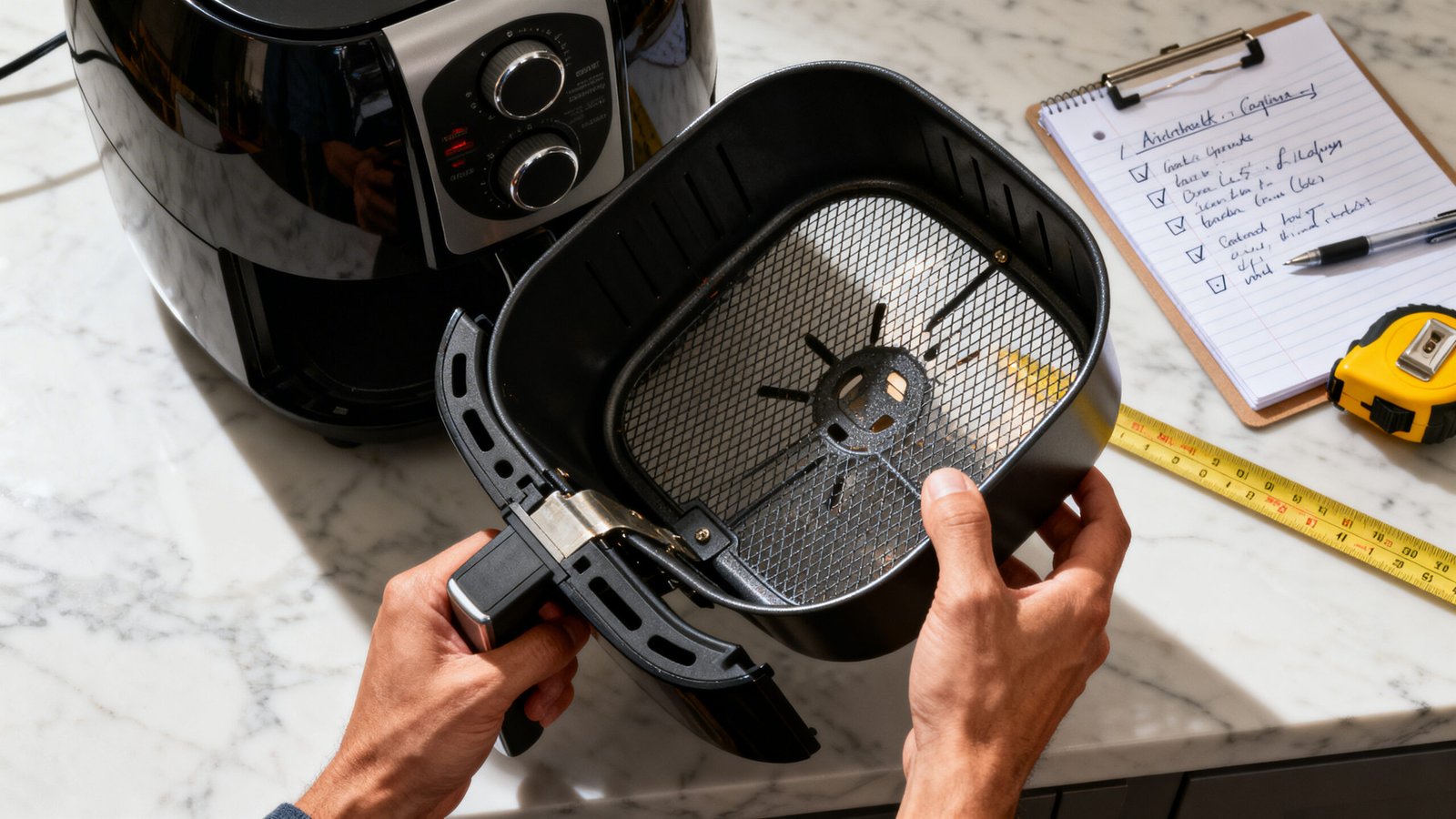
Practical loading strategies matter as much as capacity. For proteins like bone-in chicken thighs or pork chops, single-layer cooking at 375–400°F is non-negotiable for food safety and browning. Vegetables tolerate light stacking if you shake the basket halfway, but dense items like potatoes need space. If your family regularly cooks mains and sides together, dual-zone oven-style models (separate temperature controls per rack) prevent the compromise of running two sequential batches. The research gap here is glaring—current reports lack standardized usable-square-inch metrics, forcing buyers to measure baskets in-store or rely on user photos rather than spec sheets.
The Missing Tests—What Most Reviews Don’t Run
Three critical tests are absent from top-ranking air fryer reviews, leaving buyers to discover problems post-purchase. First, long-term non-stick coating integrity testing over 12+ months or 300+ cook cycles. Reviewers run a few batches at launch, miss the gradual adhesion loss that drives the 3–4 year replacement cycle, and never update rankings when baskets fail. A simple protocol exists: cook acidic tomato-based sauces and marinated proteins twice weekly for six months, then score coating for peeling, discoloration, and food release. No current top-10 article does this.
Second, detailed energy consumption comparisons with cost-per-use calculations. While the 50–75% electricity savings vs. ovens is cited broadly, precise wattage draw during preheat, cooking, and standby—and resulting annual costs at regional electricity rates—are missing. A 1500W model running 45 minutes daily at $0.15/kWh costs roughly $41/year; a 1200W unit drops that to $33. Over a 4-year lifespan, that’s $32 saved, potentially offsetting a higher purchase price. Reviews skip the math.
Third, cross-brand recipe and dehydrator performance testing with family-sized batches. Uneven cooking in high-capacity models surfaces only when you load 2 pounds of chicken wings, not the 8-ounce portions reviewers test. Dehydrator functions—critical for the air fryer with dehydrator 2026 search—need validation across multiple 6–8 hour runs with varying humidity and food density. Current reviews test one tray of apple slices and call it done.
To validate claims yourself, demand these from sellers: independent lab results for coating abrasion resistance (ASTM D4060 or equivalent), power meter readings for your typical recipes, and user reviews specifically mentioning batch sizes matching your household. If a brand won’t share or no users have tested your use case, that’s data too.
Long-Term Ownership Costs—How to Calculate Real Price-Per-Use
Total cost of ownership (TCO) separates smart buys from regret purchases. The formula is simple but rarely applied: (Purchase Price + Lifetime Energy Cost + Repair/Replacement Parts) ÷ (Expected Lifespan in Years × Uses Per Year). Here’s how to run it for two scenarios:
Scenario 1: $90 Budget Basket-Style (3-Year Lifespan)
Purchase price: $90. Energy cost: 1500W unit, 45 min/day average, 365 days/year, $0.15/kWh = ~$41/year × 3 years = $123. Replacement parts: $0 (disposable model, no parts sold). Total: $213. Uses: 365 days × 3 years = 1,095 uses. TCO per use: $0.19.
Scenario 2: $220 Premium Smart 6L Model (5-Year Lifespan)
Purchase price: $220. Energy cost: 1200W, same usage = $33/year × 5 years = $165. Replacement basket (year 4): $40. Total: $425. Uses: 365 × 5 = 1,825 uses. TCO per use: $0.23.
The premium model costs $0.04 more per use but delivers higher capacity, better coating durability (basket replacement instead of full unit), and smart features. If your household cooks twice daily, the premium’s TCO drops to $0.12/use vs. the budget’s $0.19. The affordable air fryer under 100 wins only for light users (3–4 times/week) who accept frequent replacement. Energy savings are real—air fryers cut oven costs by 50–75%—but only matter if the unit lasts. A $90 model replaced every 3 years costs $270 over 9 years; a $220 model replaced once costs $440 over 10 years but delivers superior capacity and performance throughout.
Factor in your electricity rate and usage. High-rate regions (California, Northeast U.S., Western Europe at $0.25+/kWh) amplify efficiency gains; low-rate areas see smaller deltas. Always assume 25–33% annual depreciation when calculating lifespan—the 3–4 year replacement cycle is market-proven.
Durability & Common Failures—What Buyers Must Inspect and Ask About
Coating peeling is the silent killer. Non-stick baskets lose integrity from repeated thermal cycling (room temp to 400°F and back) and mechanical stress (scrubbing, utensil contact). Users report food sticking and brown residue buildup months before visible flaking, but by then the damage is done. Pre-purchase, demand explicit coating material specs—ceramic blends generally outlast PTFE (Teflon-style) for high-heat use, though both degrade. Ask whether replacement baskets are sold separately and their cost; if a brand won’t sell parts, they expect you to replace the unit.
Uneven cooking in larger baskets stems from inadequate fan power or poor airflow channel design. High-capacity models (>6 liters) are prone because manufacturers scale volume without proportionally boosting circulation. Check for user reviews mentioning “center stays raw” or “corners burn while middle is pale”—these are airflow failures, not user error. Warranty coverage rarely includes performance degradation (gradual temp-control drift, fan noise increase), only catastrophic failure, so a 2+ year warranty signals better engineering margins.
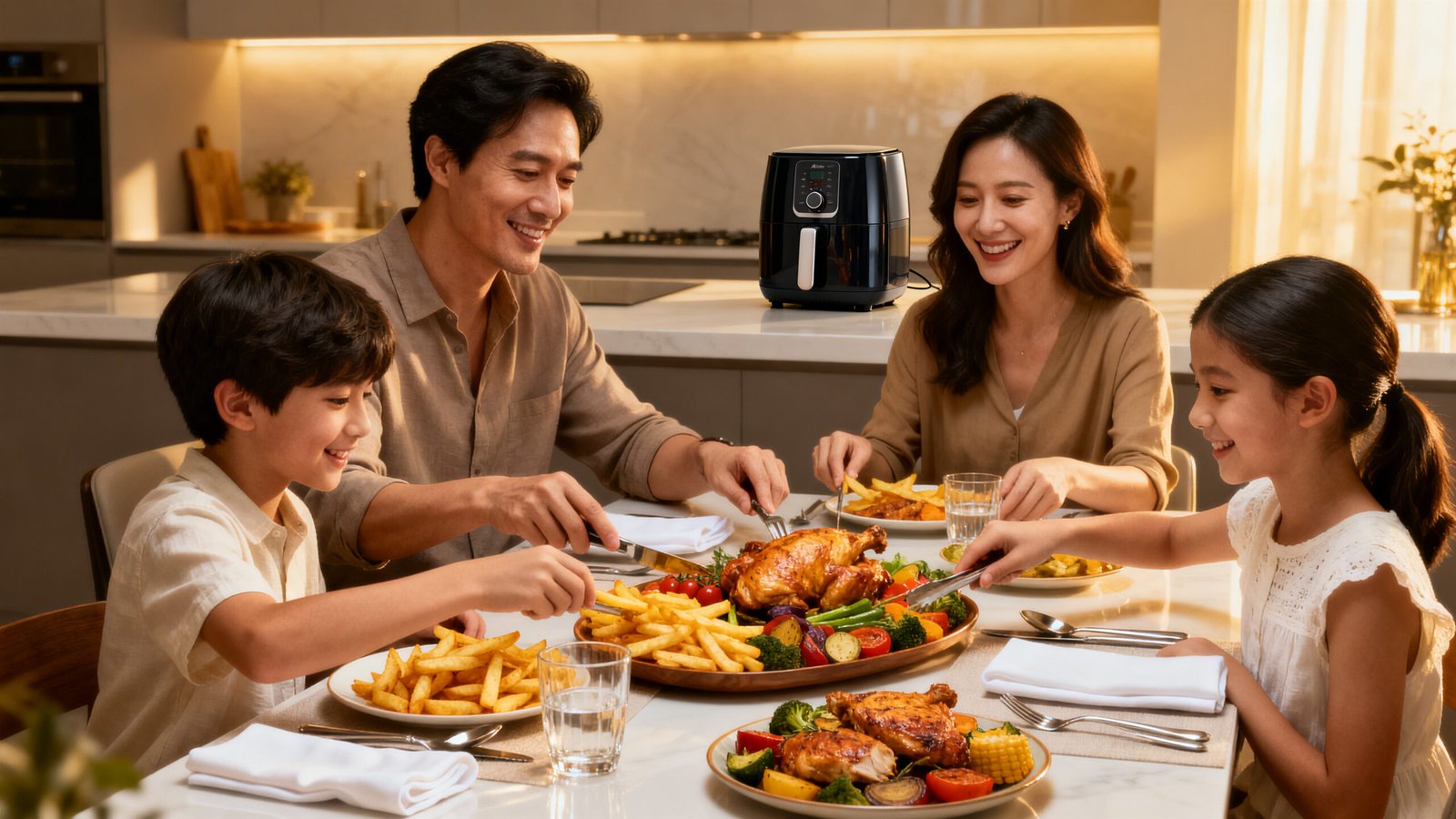
Before buying, inspect or ask about: coating manufacturer and abrasion rating, basket/tray replaceability and pricing, warranty claim process (some require photo proof of failure and original packaging), and user reviews filtered for “6 months” or “1 year” to catch early-failure patterns masked by launch-day 5-star ratings. The healthiest air fryer to buy is the one that doesn’t force you to risk flaking coating particles in your food after 18 months.
Health & Cooking Performance—What Specs Matter
Health claims around air fryers hinge on two mechanisms: oil reduction (using airflow instead of immersion frying) and potential acrylamide reduction through lower or more controlled temperatures. Both are real but underspecified in current models. Oil reduction is straightforward—air frying uses tablespoon amounts vs. cups for deep frying—but requires even heat distribution to avoid raw centers that tempt users to add more oil or cooking time, negating benefits.
Acrylamide forms when starchy foods (potatoes, breads) hit 250°F+ in low-moisture environments. Precise temperature control and avoiding overcooking can minimize this, but reviewers don’t test temp accuracy. A unit with ±20°F variance creates acrylamide hotspots. Demand specs: temperature accuracy (±5–10°F is acceptable), wattage range (1200–1800W for 4–8 liter units), and decibel levels (>65dB becomes kitchen-disruptive). The research gap is stark—no 2025/2026 measurable specs for these metrics were available, forcing buyers to rely on third-party testing or user reports.
Airflow design matters as much as wattage. Top-mounted fans with radial channels outperform rear-mounted designs for even crisping. If a brand won’t publish CFM (cubic feet per minute) ratings or airflow schematics, that’s a transparency red flag. The best air fryers 2026 should compete on published, comparable health and performance data, not vague “Turbo Crisp Technology” marketing.
Smart Features & Materials—When Connectivity and Coatings Justify the Premium
The digital segment’s 62% revenue dominance doesn’t mean every smart feature adds value. Wi-Fi connectivity justifies cost only if the app logs temperature/time data for recipe refinement, sends alerts to prevent overcooking, or integrates with energy monitors to track running costs. Generic apps with static presets are feature theater. Voice control (Alexa, Google Assistant) adds convenience for hands-free timing adjustments but doesn’t improve cooking outcomes.
Material premiums—ceramic-reinforced coatings, removable stainless steel inner shells, or modular racks—directly impact lifespan and cleaning. A $180 model with a $35 replaceable ceramic basket that lasts 5+ years beats a $90 unit with a sealed PTFE basket that fails at 3 years, even before factoring capacity or features. Smart models should publish coating certifications (FDA, LFGB) and replacement part availability upfront; if they don’t, the premium is just margin padding.
When does smart justify the cost? For households cooking daily, using diverse recipes, and tracking nutrition or energy use, a $200+ digital model with proven coating durability pays back through extended lifespan and measurable efficiency. For 3–4 times/week basic use, a reliable $110 basket-style with a 2-year warranty and replaceable parts offers better value than a $200 smart unit that’s overkill for your needs.
Dehydrator Functionality—What to Test for Real-World Results
Air fryer dehydrator modes require three specs rarely tested: temperature range down to 95–135°F (for herbs and jerky), dedicated low-speed fan settings (high speed over-dries exteriors), and sufficient vertical clearance or rack quantity to dehydrate family-scale batches (2+ pounds of fruit). The research identified no specific 2025/2026 models with validated high-performing dehydrator functionality, a significant gap for the air fryer with dehydrator 2026 keyword.
To test dehydrator claims, run a 6-hour apple-slice batch (1/4-inch thick, 2 pounds) and check for even drying—edges shouldn’t be brittle while centers remain moist. Consistent results across 3+ batches, with minimal rotation or tray-swapping, indicate good airflow design. Most air fryers fail here because their fans optimize for high-heat crisping, not low-temp moisture removal. If dehydrating is a priority, demand user reviews with photos of completed multi-batch runs, not just marketing claims.
High-capacity (>5L) is baseline for dehydrator use to fit meaningful quantities, but also check rack spacing—cramped vertical clearance forces smaller loads. Until brands publish dehydrator-specific CFM and temp-accuracy data, buyer testing remains the only validation method.
How to Balance “Under $100” vs “Healthiest / Large Capacity”—A Decision Framework
The decision hinges on use frequency, household size, and willingness to pay for durability. Use this checklist:
Choose affordable air fryer under 100 if: Your household is 1–2 people, you cook 3–4 times/week, you prioritize upfront cost over lifespan, and you accept 3-year replacement cycles. Calculate TCO assuming $90 purchase + $120 energy over 3 years = $0.19/use for daily cooking, rising to $0.25+/use for less frequent use where depreciation dominates.
Choose healthiest/large capacity premium if: Your household is 4+ people, you cook 5–7 times/week, you want <5-year replacement cycles, and upfront $200–250 fits your budget. Premium features—smart controls, replaceable parts, high-capacity (>5.3 qt)—pay back through lower per-use cost ($0.12–0.15 for daily use), better health outcomes from precise temp control, and reduced replacement hassle. The best large capacity air fryer for a family of four isn’t the cheapest 6-liter unit—it’s the one with proven even cooking, replaceable baskets, and a warranty backing 4+ year durability.
Payback calculation: If a $220 premium lasts 5 years vs. a $90 budget lasting 3, the premium costs $44/year vs. $30/year upfront, but saves ~$8/year in energy and avoids mid-lifespan replacement shopping and setup. For daily users, the premium wins; for occasional users, the budget’s simplicity and lower sticker price are rational.
Practical Buyer Checklist & Pre-Purchase Questions
Walk through this checklist before purchase, whether online or in-store:
- True usable capacity: Demand internal basket dimensions in liters/quarts AND square inches of floor area. Calculate whether your typical meals fit in single layers.
- Replaceable parts: Confirm baskets, racks, and trays are sold separately. Get part numbers and prices—if unavailable, expect to replace the entire unit.
- Coating material: Ask for specific non-stick type (ceramic, PTFE-free, etc.) and any certifications. Avoid vague “premium non-stick” claims.
- Warranty: 24+ months signals quality; 12 months is industry minimum. Confirm claim process—some require photo proof and original packaging you won’t have in year 2.
- Energy specs: Request wattage during cooking (not just peak), and calculate annual cost at your electricity rate. A 300W difference is $12–15/year.
- Return policy: 30–60 day windows let you run real-world batch tests. Cook your largest typical meal within the return period to catch capacity or even-cooking issues.
- User reviews at 6–12 months: Filter reviews by date to see post-honeymoon phase performance. Look for coating, fan noise, and uneven-cooking mentions.
Sample seller questions: “What is the usable basket floor area in square inches?” “Are replacement baskets sold separately, and what do they cost?” “What coating material is used, and is it certified PFOA/PTFE-free?” “Does the warranty cover performance degradation or only complete failure?” Most sellers can’t answer—push back or shop elsewhere. The best air fryer for family of 4 is the one where the seller transparently provides these details without deflection.
Appendix: Recommended Independent Tests for Reviewers
To close the research gaps identified and serve future buyers, reviewers should adopt these protocols:
12-Month Accelerated Non-Stick Coating Integrity Test
Cook 300+ cycles over 12 months with high-challenge foods: marinated proteins, tomato-based sauces, and breaded items. Document coating condition with macro photos monthly. Score adhesion, discoloration, and food-release performance on a 1–10 scale. Publish results as a durability index, not just pass/fail at launch.
Standardized Energy-Use Test Per Cooking Cycle
Use a calibrated power meter (e.g., Kill A Watt) to measure wattage during preheat, active cooking, and standby for three standard recipes: 1 lb frozen fries (20 min, 400°F), 4 chicken thighs (25 min, 375°F), and 2 lbs mixed vegetables (15 min, 380°F). Report total kWh per recipe and annual cost at $0.15/kWh baseline. Compare across brands in a table.
Family-Sized Batch Cooking and Dehydrator Throughput Test
Load baskets to 80% rated capacity with real-world family meals (not single-layer marketing portions). Measure temperature variance across basket zones with probe thermometers. For dehydrators, run 3 consecutive 6-hour batches of apple slices and jerky, documenting consistency and edge-to-center evenness. Fail any model requiring manual rotation more than once per batch.
Temperature Accuracy and Decibel Measurement
Use oven thermometers at multiple basket locations and compare to set temperature over 30 minutes. Report max variance. Measure sound levels at 3 feet with a decibel meter during preheat and cooking. Publish both specs in a comparison table. Models with >±10°F variance or >65dB should be flagged for buyer awareness.
These tests are cheap to run, highly replicable, and directly address the top 3 coverage gaps in current reviews. Until brands publish this data, independent reviewers must fill the void.
Conclusion
The best air fryers 2026 aren’t defined by hype cycles or influencer partnerships—they’re distinguished by measurable durability, transparent capacity specs, energy efficiency that translates to real dollar savings, and smart features that solve actual cooking problems rather than pad spec sheets. The market’s growth to US$10.2 billion reflects genuine demand, but the 3–4 year replacement cycle driven by coating failures reveals an industry still prioritizing planned obsolescence over longevity. Your buying decision should center on total cost of ownership, verifiable performance in family-sized batches, and warranty/replaceability signals that a manufacturer stands behind their product beyond the first year.
For families of four, the best large capacity air fryer balances >5.3-quart usable volume with proven even-cooking performance and replaceable baskets that extend lifespan to 5+ years. For budget-conscious buyers, the affordable air fryer under 100 can deliver basic low-oil benefits, but only if you accept shorter lifecycles and calculate the true per-use cost including replacement frequency. And for health-focused households, the healthiest air fryer to buy is the one with published temperature accuracy, durable non-toxic coatings, and the capacity to handle whole meals without forcing compromises that add oil or cooking time.
Demand transparency. Measure baskets before buying. Calculate energy costs. Read 6–12 month reviews, not launch-day hype. The right air fryer for 2026 is the one that fits your actual cooking patterns and budget reality, backed by evidence, not marketing claims.
FAQ
What capacity air fryer does a family of 4 actually need?
A family of four requires at least 5.3–6 quarts (5–5.7 liters) with a minimum 75 square inches of usable basket floor area. This allows single-batch cooking of four chicken breasts or 1.5 pounds of vegetables without stacking, which causes uneven cooking. Verify internal dimensions, not just total volume, since narrow-tall baskets reduce usable single-layer space. High-capacity models (>5L) dominate this segment but check user reviews for even-cooking performance at full loads.
Are air fryers with smart features worth the extra cost?
Smart features justify premiums only when they deliver measurable value—app-based energy tracking, temperature
—